
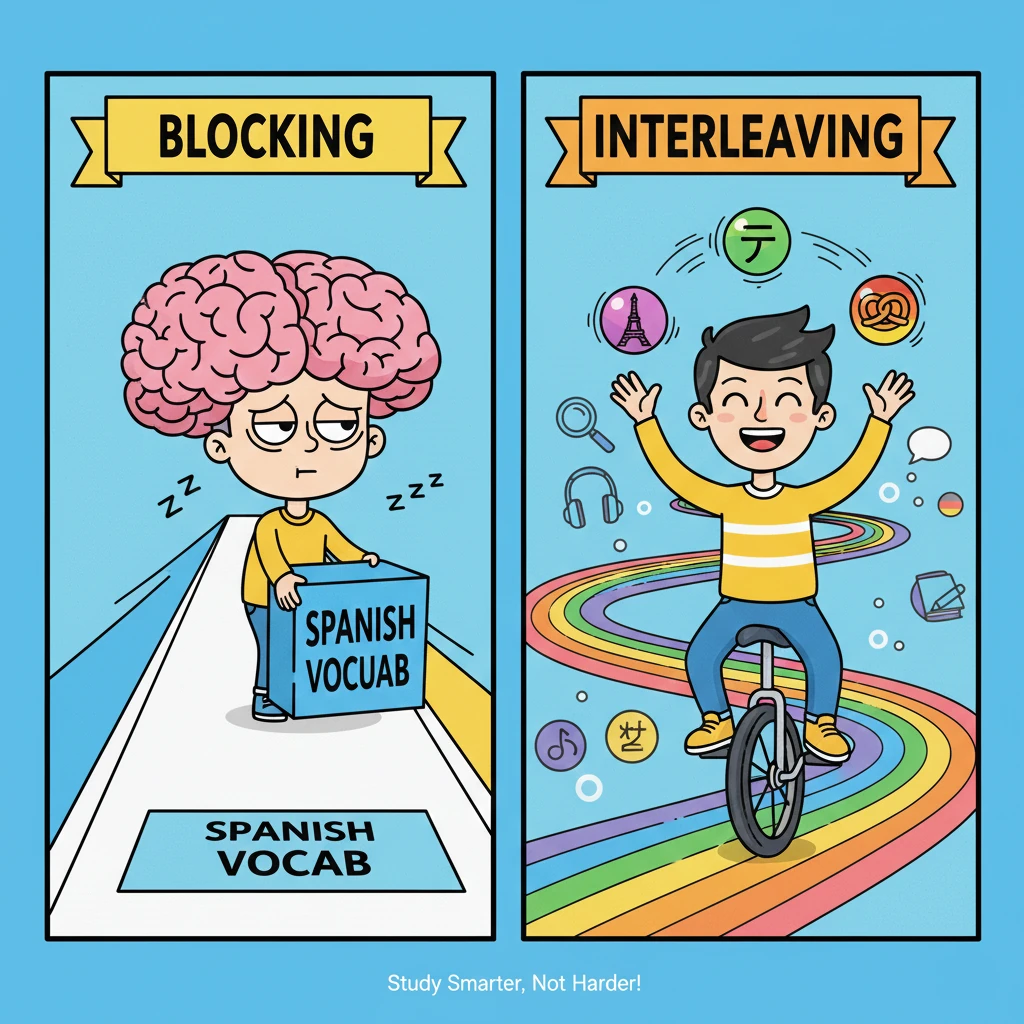
Are you trying to juggle Spanish, Mandarin, and maybe even a little German? It often feels like you should dedicate one hour solely to German vocabulary, then one hour strictly to Spanish grammar. This strategy, called “blocking,” feels organized, but it’s often the least effective way to learn!
Ready for a game-changer backed by cognitive science? Meet Interleaving—the smarter, more efficient way to study multiple languages.
What is Interleaving, Anyway?
Interleaving is the practice of mixing different subjects or topics within a single study session. Instead of dedicating 90 minutes to just one language, an interleaved session might look like this:
- 20 minutes: Review Spanish imperfect tense.
- 20 minutes: Learn 10 new Mandarin characters.
- 20 minutes: Practice German noun genders.
- 10 minutes: Rapid-fire translation quiz, switching between all three.
The Problem with Blocking (Studying one thing for too long)
When you block (e.g., only study Spanish for an hour), your brain knows exactly what’s coming. This makes the task easier and gives you a feeling of competence, but it doesn’t build long-term retention. You’re simply using short-term memory.
The Science: Why Interleaving Works Wonders
Interleaving isn’t just a study trick; it’s a proven cognitive strategy that forces your brain to work harder, leading to stronger, more flexible memory retrieval.
1. Forces Discriminative Practice
When you switch languages or concepts, your brain must constantly stop, identify the context (Is this Spanish or German?), and select the correct rules and vocabulary to apply. This process is called discriminative practice.
Research by Drs. Rohrer and Taylor (2012) on perceptual and motor skill learning demonstrated that interleaving significantly improved long-term retention and the ability to distinguish between similar concepts, compared to blocked practice. The brain must learn when to use a skill, not just how to use it.
2. Strengthens Retrieval Practice
Every time you switch contexts, you are performing a retrieval practice (pulling information out of long-term memory) under a slightly different condition. By making the study process harder (by mixing things up), you create more durable learning and make information easier to recall later. Interleaving is one of the key desirable difficulties.
3. Helps Avoid Mental Fatigue
Switching topics can provide a mini-reset for your brain, preventing the common burnout associated with staring at the same vocabulary list for an hour. The variety keeps the study session fresh and engaging.
How to Interleave Your Language Study Today
Ready to put this into practice? Try these simple strategies:
- Mix the Skills: Don’t just mix languages; mix skills within one language (e.g., 15 mins listening practice, 15 mins writing an email, 15 mins reading a short article).
- The 20-Minute Rule: Set a timer for 20-30 minutes and focus intensely on one language or concept. When the timer rings, move to a completely different language or skill.
- Flashcard Shuffle: When reviewing digital or physical flashcards, don’t keep the languages separate! Create one huge deck and let the French verbs pop up right after the Japanese adjectives. This is pure discriminative practice!
Embrace the beautiful chaos of interleaving. It might feel a little messy at first, but your brain will thank you for the long-term fluency boost!
Include Aprelendo in Your Interleaving Schedule
If you’re looking for a systematic way to apply the interleaving principle within your single-language study, consider methods that force you to rapidly switch between skills.
We recommend checking out Aprelendo, a platform that implements a powerful method called Total Reading. This approach perfectly aligns with the principles of interleaving and desirable difficulty by breaking down a single text into multiple, distinct tasks:
Aprelendo’s 5 Phases of Total Reading:
- Phase 1 – Reading: Grasp the general meaning and use the built-in dictionary (Vocabulary acquisition).
- Phase 2 – Listening: Immerse yourself in the audio (Aural comprehension).
- Phase 3 – Speaking: Read the text out loud, mimicking the recording to train mouth muscles (Pronunciation and speaking practice).
- Phase 4 – Dictation: Listen to the audio and try to write the words you previously marked as difficult (Reinforcing spelling and retrieval).
- Phase 5 – Review: Actively recall and practice all the marked words and their usage, pushing them into active vocabulary (Long-term retention).
By using the same short text as the subject, Aprelendo forces you to switch rapidly between reading, listening, speaking, and writing. This is essentially interleaving your language skills, creating that necessary “desirable difficulty” to make your learning durable, systematic, and incredibly efficient.
Leave a Reply