
You’ve probably taken a quiz or heard someone say “I’m a visual learner,” “I learn best by listening,” or “I’m totally kinesthetic.”
It feels true, but modern neuroscience and learning science show these beliefs are neuromyths. Intuitively appealing ideas that aren’t actually backed by research on how our brains learn best.
For language learners in particular, buying into the idea of static “learning styles” can waste time, impact confidence, and distract from strategies that are proven to build real fluency.
Let’s unpack what research says about this myth and then explore what actually works when you’re learning a language.
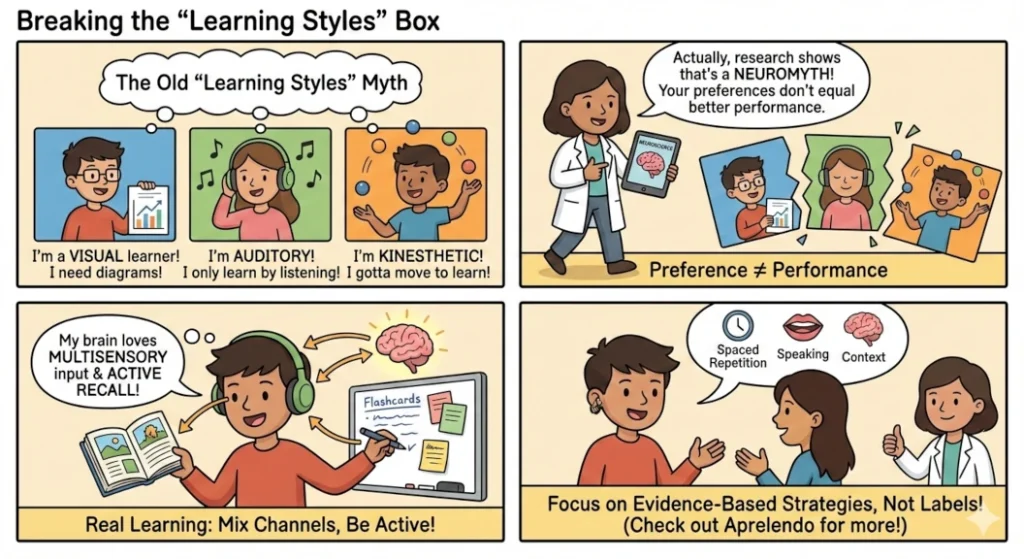
What Exactly Is the “Learning Styles” Myth?
The traditional learning styles idea suggests people are divided into fixed categories like:
- Visual learners (prefer images, diagrams)
- Auditory learners (prefer sound, conversation)
- Kinesthetic learners (prefer movement, tactile interaction)
The assumption is that your brain learns better when instruction matches your category.
👉 But here’s the key scientific insight:
A person’s preference for a way of receiving information doesn’t mean their brain actually learns better that way in a measurable way. (Poorvu Center for Teaching and Learning)
This is why most research labels learning styles a neuromyth — a widely believed idea about how our brains work that doesn’t hold up under scientific scrutiny.
What Research Really Says: It’s Preference, Not Performance
Multiple studies and reviews show clear results:
✅ People have preferences — some like to read, some like to listen, some like doing activities.
❌ But those preferences do not predict better learning outcomes when teaching is matched to them.
An influential review of educational research found no evidence that “matching instruction to a person’s preferred learning style improves learning.” (Poorvu Center for Teaching and Learning)
Another meta‑analysis found that even when small benefits showed up occasionally, they were too inconsistent and weak to justify time and effort. (Frontiers)
In simpler terms:
👉 just because you like learning a certain way doesn’t mean that way makes you learn better.
A Neuroscience Perspective: The Brain Is Not “Modular Like That”
Why does this myth exist in the first place?
Learning styles trace back to ideas from the 1980s (like the VARK model), which assumed the brain uses distinct systems for visual, auditory, and kinesthetic processing.
But modern brain science shows that while different sensory systems do exist, the brain isn’t wired in strict silos. When we learn language, multiple areas of the brain activate and work together, not separately based on some “style box.”
Instead:
✅ The brain integrates visual, auditory, motor, and contextual information.
✅ Learning strengthens connections across systems — called neuroplasticity.
✅ Language learning isn’t about “your style” — it’s about how the brain builds patterns and retrieves them efficiently.
This aligns with what neuroscientists call multisensory learning — we learn best when the brain gets rich, interconnected input. (Wikipedia)
The Real Science of How the Brain Learns Languages
Instead of trying to fit into a style category, research shows that strong language learning works through cognitive principles that are universal to all brains.
Here are the ones supported by neuroscience:
🔹 Spaced repetition — revisiting material at increasing intervals improves memory consolidation.
🔹 Active recall — trying to produce language (speak/write) enhances learning better than passive listening.
🔹 Contextual learning — linking vocabulary and grammar to real examples boosts pattern learning.
🔹 Feedback and error correction — helps the brain refine and strengthen connections.
All of these work regardless of any self‑reported “style.”
This matches what cognitive science says: learning is about effortful processing and use, not comfortable preference.
Why the “Learning Styles” Myth Persists
If the idea doesn’t hold up scientifically, why does it stay so popular?
Here are a few reasons:
✅ It feels intuitively true — people notice they like certain study activities better.
✅ It’s easy to categorize yourself — and labels feel empowering.
✅ Many teachers were trained with this myth embedded in educational materials.
But preference is not proof of improved learning — and assuming so can limit your experimentation with strategies that actually work.
What Works for Language Learners (Evidence‑Based Strategies)
Instead of thinking in terms of styles, focus on strategies proven to support real language acquisition:
✅ Mix Multiple Channels (Multisensory Engagement)
Using multiple senses together — reading a sentence, saying it aloud, and associating it with a visual or physical action — helps the brain form stronger links. (Wikipedia)
This multisensory approach fits how the brain naturally integrates information.
✅ Practice Retrieval, Not Just Exposure
Passively hearing or seeing words doesn’t build stable memory.
The brain learns when it tries to recall, even if it fails at first.
✔ Say new words aloud before checking the answer.
✔ Try writing sentences without looking at notes.
This active recall is one of the most efficient learning mechanisms known.
✅ Spaced Practice Beats Cramming
Studying the same words repeatedly in one sitting feels productive — but it creates only fragile memory.
Spaced repetition — revisiting material over days or weeks — builds durable memory traces in the brain. (Wikipedia)
Tools like spaced flashcards or review schedules tap into this science automatically.
✅ Use Language in Meaningful Contexts
Your brain stores patterns, not isolated facts.
So:
✔ Learn vocabulary in sentences.
✔ Use the language with real communication (chat, journaling, speaking with others).
✔ Immerse yourself in media you enjoy.
Meaningful use forms connections between forms, meaning, and use — exactly what language brains thrive on.
✅ Learn from Errors and Feedback
Feedback helps the brain correct and strengthen neural pathways.
Try:
✔ Recording yourself and checking pronunciation.
✔ Getting language partner corrections.
✔ Taking quizzes that give immediate answers.
The brain’s error signals are powerful learning moments.
Putting It All Together: Your Personalized, Science‑Backed Learning Plan
Instead of defining yourself as one “style,” think of language learning as a flexible process where you:
✅ Mix multiple senses and modalities.
✅ Actively recall and produce language.
✅ Space your study over time.
✅ Use language in real contexts.
✅ Seek feedback and refine.
This approach matches how the brain learns, based on decades of neuroscience and cognitive research, not intuition or personality quizzes.
Takeaway: Your Brain Is Flexible — Not Fixed in a Style
The idea that you are a fixed “visual,” “auditory,” or “kinesthetic” learner is a myth, not science. (Wikipedia)
What does matter is engaging your brain in meaningful processing, active use, repetition, and connection — because that’s how the neural circuits for language become stronger and more automatic.
So next time you study a language, ditch the label — and focus on what actually builds fluency.
💡 Let Your Brain Learn the Way It Was Built To💡
If you’re ready to stop guessing and start learning with neuroscience on your side, check out Aprelendo’s Total Reading.
It’s not just another “method” — it’s a system built around:
- Spaced repetition (so vocabulary sticks),
- Context-rich reading (for grammar + meaning integration),
- Active decoding (training your brain to think in the language),
- And multisensory input (the way real neural networks form).
Total Reading helps you absorb language the way native speakers do, not by style-matching, but by processing and using language as a whole system.
So if you’re done with learning styles and ready to learn smarter, start with what the brain actually wants.
🔗 Explore Aprelendo and experience fluency through science.
Leave a Reply