We’ve all heard the myth: “You can be fluent in three months!” While that’s great for marketing, the truth is a little more complex. Learning a language is a marathon, not a sprint—but science gives us clear benchmarks to help set realistic expectations.
So, how much time do you actually need? Let’s dive into the research!
The Foreign Service Institute’s Time Estimates
One of the most widely cited resources on language learning time comes from the U.S. Foreign Service Institute (FSI). The FSI trains U.S. diplomats and, based on decades of data, categorizes languages by their difficulty for a native English speaker to reach “Professional Working Proficiency.”
Here’s a breakdown of their approximate class hour estimates:
| Category | Description | Approx. Class Hours |
| Category I | Languages closely related to English (e.g., Spanish, French, Italian) | 600-750 hours (Approx. 24-30 weeks) |
| Category II | Languages with some linguistic/cultural differences (e.g., German, Indonesian) | 900 hours (Approx. 36 weeks) |
| Category III & IV | Languages with significant differences (e.g., Russian, Turkish, Vietnamese) | 1,100 hours (Approx. 44 weeks) |
| Category V | “Super-hard” languages (e.g., Arabic, Mandarin, Japanese, Korean) | 2,200 hours (Approx. 88 weeks) |
Source: U.S. Foreign Service Institute (FSI) Language Training Load
The takeaway? A “fast” language like Spanish still requires about 600 hours of focused study and practice to become professionally proficient. This isn’t three months of casual Duolingo—it’s a significant commitment.
Four Factors That Speed Up (or Slow Down) Your Learning
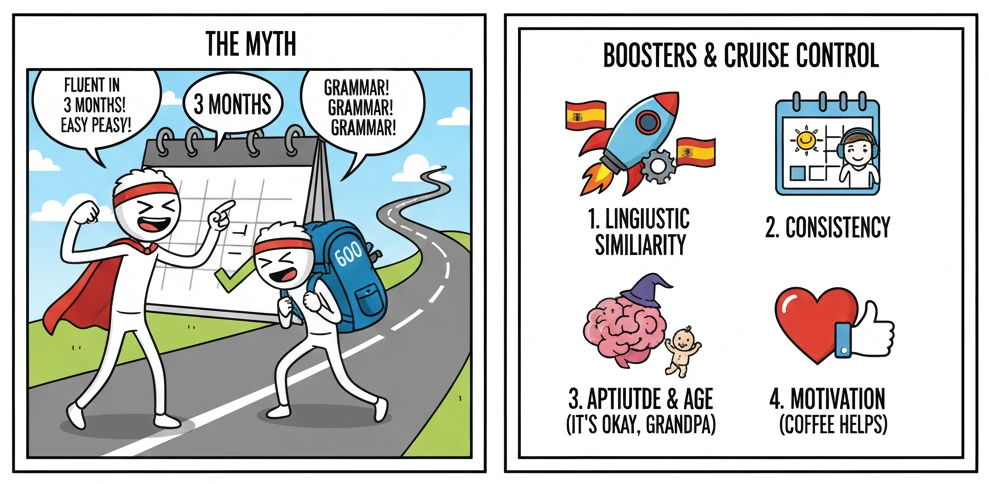
Science shows that the hours needed are just an average. Your individual journey is impacted by several key factors:
1. Linguistic Distance (Your Native Language)
The FSI’s data already reflects this. If your native language shares grammar, vocabulary, and sounds with your target language, you’ll have a massive head start. For an English speaker, learning Dutch is faster than learning Korean.
2. Time Spent & Consistency
Research consistently shows that the total amount of time spent with the language matters most. However, consistency is critical. A study by the Center for Applied Linguistics found that adults who are highly motivated and have consistent exposure, especially immersion, can make rapid progress in communicative skills.
3. Aptitude and Age
While the debate on the “Critical Period” for language acquisition is ongoing, studies suggest that children are more adept at implicit learning (absorbing language naturally) and achieving native-like pronunciation (Patkowski, 1980). However, adults have an advantage in explicit learning—they are often better at understanding and applying grammar rules (Singleton, 2014). It’s never too late to learn!
4. Motivation and Attitude
Psychological factors are a huge predictor of success. High integrative motivation (the desire to become part of the culture) and a positive attitude toward the learning process are linked to better long-term outcomes (Gardner, 1985). If you genuinely love the process, you’re more likely to put in the hours needed!
The Realistic (and Exciting) Conclusion
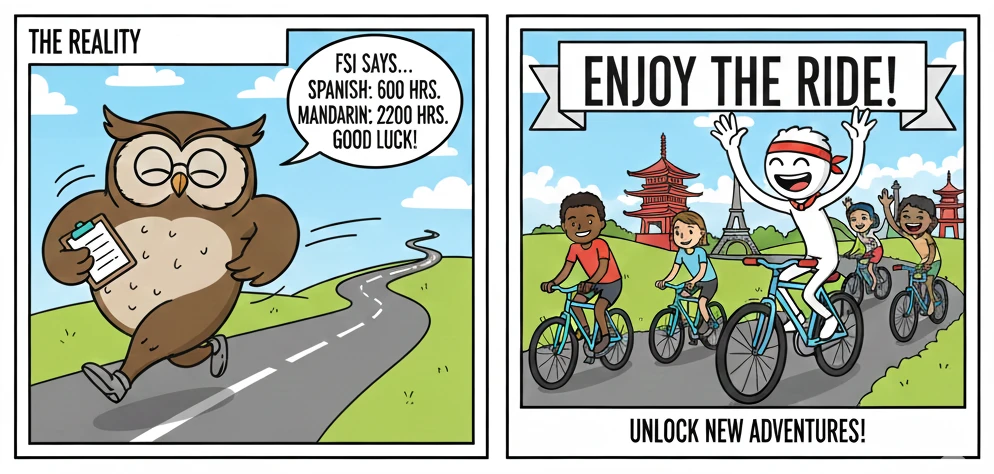
Instead of asking, “How long until I’m fluent?” a more helpful question is, “How many hours a week can I consistently commit?“
- If you commit 10 hours a week to a Category I language (like Spanish), you could reach Professional Working Proficiency in about 60-75 weeks (just over a year).
- If you commit 5 hours a week, that timeline doubles to about two to three years.
But here’s the good news: You don’t need “fluency” to enjoy a language. You can achieve basic conversational fluency (enough to travel and connect with people) in much less time—often a few hundred hours!
Stop worrying about the finish line and start focusing on the journey! Every hour you put in moves you closer to unlocking a new world.
Ready to start your language journey? Try Aprelendo.
Leave a Reply