
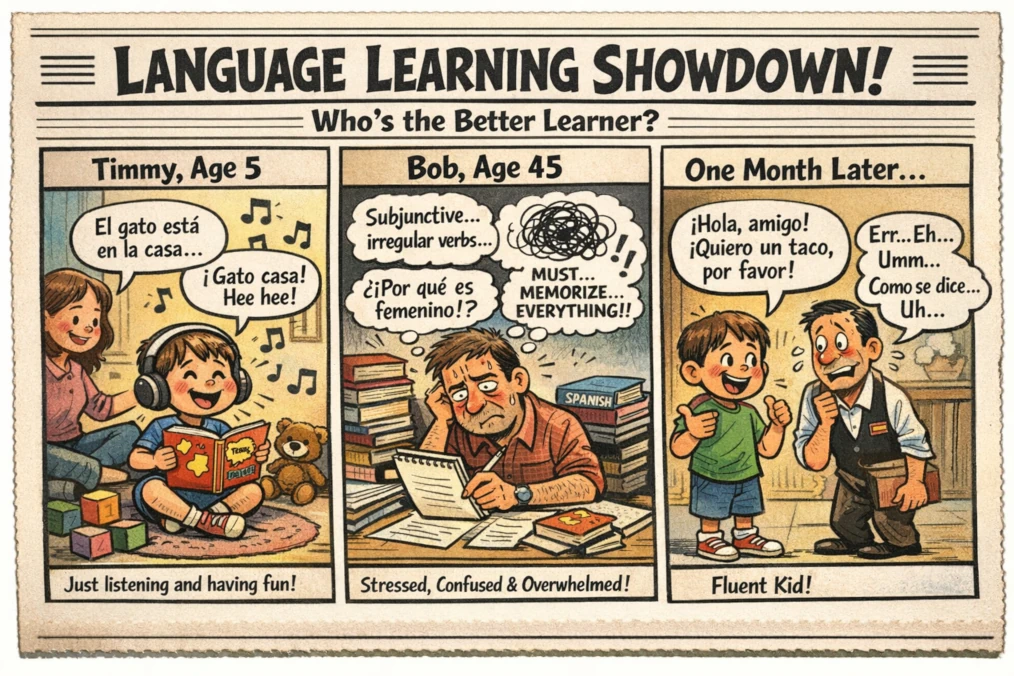
Why do children seem to absorb languages like sponges while adults struggle with flashcards and grammar rules?
This isn’t nostalgia or mythology. It’s neuroscience.
The good news is that children don’t succeed because they’re “smarter” or have magical brains. They succeed because they use learning strategies that perfectly match how the brain is wired to learn languages.
And here’s the real payoff: adults can copy these strategies without pretending to be kids, without endless free time, and without moving abroad.
This article unpacks the scientific core behind child language learning—brain plasticity and statistical learning—and then translates it into practical, adult-friendly strategies you can start using today.
But, before strategies, we need to understand why children’s methods work.
Brain Plasticity: Not Gone—Just Misused
Neuroplasticity refers to the brain’s ability to reorganize itself by forming new neural connections. For years, researchers believed plasticity vanished after childhood. That idea is outdated.
Modern neuroscience shows that adult brains remain plastic—but plasticity is experience-dependent.
In other words, how you practice matters more than how old you are.
That means adults learning a new language can still develop native-like neural patterns when exposure is frequent, meaningful, and contextual.
Statistical Learning: The Hidden Superpower
Children don’t consciously study grammar. Instead, they rely the brain’s ability to detect patterns in input automatically.
Infants can detect which sounds, syllables, and words frequently occur together without being taught.
This means:
- They learn word boundaries by probability
- They infer grammar from repetition
- They internalize pronunciation by exposure
No explanations required.
Adults still possess this ability—but we often block it by overthinking.
Aha moment:
👉 Grammar explanations don’t create fluency. Pattern exposure does.
What Children Do Better Than Adults (Scientifically Speaking)
Let’s break down the specific behaviors children use—and why they work so well.
1. Children Prioritize Input Over Output
Children listen a lot before they speak.
Months—sometimes years—of rich input come before confident output. Adults? We try to speak on Day One.
Why This Works
Listening builds:
- Phonological maps (sound categories)
- Rhythm and intonation models
- Implicit grammar expectations
Neuroscience shows that comprehension networks activate before production networks.
Children follow the brain’s natural order. Adults fight it.
How Adults Can Copy This
You don’t need to stay silent for six months—but you do need to flip the ratio.
Try this rule:
👉 For every 10 minutes of speaking practice, do 30 minutes of listening.
Focus on:
- Short audio with transcripts
- Repeated listening
- Content you mostly understand (60–80%)
2. Children Learn in Context—Not Abstractions
Children never learn words in isolation.
They hear “apple” while holding an apple.
They hear “no” during emotional moments.
They hear verbs embedded in actions.
Why This Works
Context activates multiple brain systems at once:
- Sensory cortex
- Emotional centers (amygdala)
- Memory consolidation (hippocampus)
This creates denser neural networks, making recall faster and more durable.
Flashcards? Single-channel learning.
Context? Multi-channel encoding.
How Adults Can Copy This
Instead of memorizing lists:
- Learn phrases inside mini-stories
- Attach words to routines (coffee, commute, workouts)
- Use visual + audio together
Example:
Not: “to book = reservar”
But: “I booked a table. The restaurant was full.”
3. Children Repeat Without Getting Bored
Children hear the same story dozens of times—and love it.
Adults call this “inefficient.”
Brains call it optimization.
Why Repetition Is Essential
Repetition strengthens synaptic connections through long-term potentiation—the biological basis of learning (Kandel, 2001).
But here’s the twist:
The brain prefers repeated meaning, not repeated drills.
Children repeat:
- Stories
- Songs
- Routines
Each repetition adds nuance, not fatigue.
How Adults Can Copy This
Don’t chase endless new content.
Instead:
- Re-listen to the same material across days
- Re-read familiar texts faster each time
- Notice new details in old input
Aha moment:
👉 Boredom isn’t failure—it’s the signal that learning is consolidating.
4. Children Tolerate Ambiguity (Adults Panic)
Children don’t stop a conversation to ask, “What does that mean?”
They let meaning emerge.
Adults, trained by school systems, feel unsafe without full understanding.
Why Ambiguity Accelerates Learning
Statistical learning requires uncertainty.
If everything is explained, the brain stops predicting.
Research shows that desirable difficulty—slight confusion—enhances retention.
Children live in this zone constantly.
How Adults Can Copy This
Practice partial understanding:
- Watch content without pausing
- Accept 70% comprehension
- Guess meaning from context
This is uncomfortable—but neurologically powerful.
5. Children Learn for Communication, Not Perfection
Children don’t care about mistakes.
They care about being understood.
Adults reverse this priority—and pay the price.
Why Perfection Blocks Fluency
Fear activates the brain’s threat system, which suppresses language production networks.
Children are neurologically safe:
- No grades
- No social judgment
- No identity threat
How Adults Can Copy This
Reframe errors as:
- Data, not failure
- Feedback, not identity
Set communication goals, not correctness goals.
Example:
- ❌ “Speak without mistakes”
- ✅ “Order food successfully”
Learn a second language as a bridge, not a test.
The Adult Advantage (Yes, You Have One)
Here’s what children don’t have:
- Metacognition
- Goal setting
- Time compression
- Strategic selection
Adults can engineer environments that trigger child-like learning—faster.
You don’t need:
- 10 hours a day
- Native parents
- Immersion abroad
You need:
- High-quality input
- Repetition with meaning
- Predictable routines
This is why modern language tools—when grounded in neuroscience—can outperform traditional classrooms.
The Practical Payoff: “Infantile” Strategies for Busy Adults
Let’s turn science into a realistic weekly system.
A Brain-Aligned 20-Minute Routine
5 minutes – Familiar input (repetition)
10 minutes – New but comprehensible content
5 minutes – Low-pressure output (shadowing or paraphrasing)
No drills. No translation. No guilt.
Children Aren’t Better Learners. They’re Better Aligned.
Children don’t learn languages better than adults.
They learn in harmony with the brain’s design.
Adults can do the same—once we stop fighting biology and start leveraging it.
Key takeaway to remember:
👉 Fluency isn’t built by effort alone. It’s built by alignment.
And alignment? That’s something adults are uniquely capable of—once they know the rules of the brain.
Leave a Reply