
Why You’re Motivated Today—and Burned Out Tomorrow
If you’ve ever felt fired up to study a language one day, then ghosted your flashcards the next, you’re not lazy. You’re human.
Motivation is a neurochemical wave, and just like waves, it crashes. Neuroscience shows that motivation spikes when novelty or reward is expected—especially through dopamine release. But that same dopamine drop-off is why new habits feel exciting at first but hard to maintain.
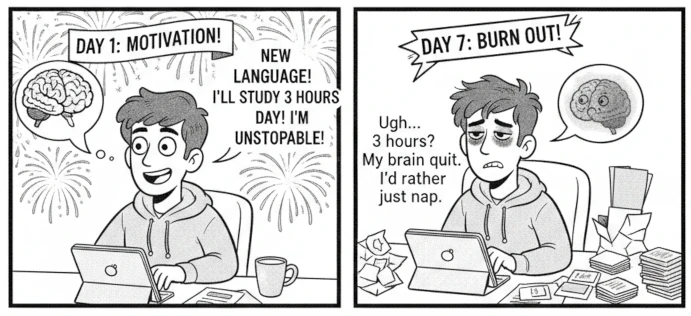
So how do polyglots, top performers, and self-learners keep going when the spark fades? The answer isn’t more motivation. It’s habit.
Let’s dive into the brain systems that make motivation unreliable and habits unstoppable—and how you can build a language learning system that works even on your most unmotivated days.
The Brain’s Reward System: Why We Chase Dopamine (and Get Burned)
Every time you open Aprelendo or crack open your grammar book, your brain performs a quick calculation:
“Is this worth my energy?”
Enter dopamine, your brain’s internal reward currency. It’s not just the “pleasure molecule”, it’s actually a prediction signal that spikes when something feels better than expected.
Here’s the catch: dopamine doesn’t sustain motivation, it anticipates it. The first time you get that “Day 1” badge, dopamine spikes. By Day 4? The brain adjusts, and the badge feels… meh.
What this means: You can’t rely on dopamine to keep you going. Your brain adapts to rewards. So the key isn’t more novelty or hype—it’s creating a system that works regardless of mood.
Habits: The Brain’s Energy-Saving Secret Weapon
Once an action becomes a habit, it moves from the prefrontal cortex (effortful decision-making) to the basal ganglia—a brain region designed for automatic behavior.
Habits cost less energy to perform. You don’t argue with yourself about brushing your teeth. Your brain just cues, executes, and rewards.
Language learners who build study into habit loops—not emotional bursts—are the ones who stay consistent long enough to see real results.
The Habit Loop: Cue → Routine → Reward
Behavior change isn’t about willpower—it’s about wiring.
Every habit forms through three steps:
- Cue – A trigger (e.g., finishing breakfast)
- Routine – The behavior (e.g., 5 minutes of Spanish audio)
- Reward – The dopamine hit (e.g., checking off your streak)
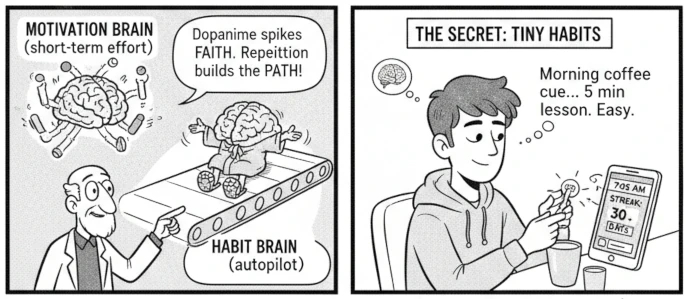
Neuroscience shows that repetition in the same context strengthens the neural pathways that make this loop automatic. Motivation fades. Neural loops stick.
Motivation vs. Habit: Which Wins in Language Learning?
| Factor | Motivation | Habit |
|---|---|---|
| Fueled by | Dopamine novelty spikes | Repetition & neural pathways |
| Feels like | “I want to” | “I just do it” |
| Brain region | Prefrontal cortex | Basal ganglia |
| Longevity | Short-term | Long-term |
| Energy cost | High | Low |
Conclusion: Motivation might get you started, but habit gets you fluent.
Why Most Study Plans Fail (and What to Do Instead)
Most people build study routines around feeling ready. But readiness is fragile. Life just happens.
So instead of asking, “How can I stay motivated?” ask:
“How can I make studying so automatic I do it without thinking?”
Neuroscientific Tip: Anchor your study to an existing habit. This is called habit stacking.
Example:
“After I make coffee, I’ll do an Aprelendo lesson.”
This creates a consistent cue and reduces decision-making fatigue.
Practical Payoff: Design a Study System That Runs Itself
Here’s how to build a brain-friendly system that doesn’t rely on motivation:
1. Shrink the Task
Your brain resists big demands. Instead of “study French for 1 hour,” try:
“Listen to 1-minute French audio while brushing teeth.”
Small wins keep dopamine flowing and reduce resistance.
2. Use a Visual Tracker
The brain loves progress. Habit-tracking apps or even a paper calendar feed your reward system.
Aprelendo integrates this into your stats dashboard, so every completed session feeds the feedback loop with real-time visual cues.
3. Time It Right
Your brain’s alertness peaks 1–2 hours after waking. Even 5 minutes of study in this window boosts retention due to elevated norepinephrine and BDNF (brain-derived neurotrophic factor).
4. Reward Strategically
Make the reward immediate. Pair your study with something enjoyable:
“After my flashcard session, I’ll have my favorite snack.”
Or better yet, let the Aprelendo reward system gamify this for you.
Final Thought: Make Fluency Boring (in the Best Way)
When something becomes boringly automatic—like brushing your teeth—you’ve won. The goal isn’t endless hype.
It’s effortless repetition.
That’s how habits, not motivation, build fluency.
And if you’re looking for a platform designed around this exact science—with automatic cues, tiny tasks, and built-in visual tracking, Aprelendo is built to turn neuroscience into a daily language rhythm that sticks.
Because the brain doesn’t need fireworks.
It just needs a good loop.
Leave a Reply