
Have you ever watched a show in English (or another language) and thought:
“I understood everything!”
…But when someone talks to you in real life, your brain goes silent?
This isn’t laziness or shyness. It’s neuroscience.
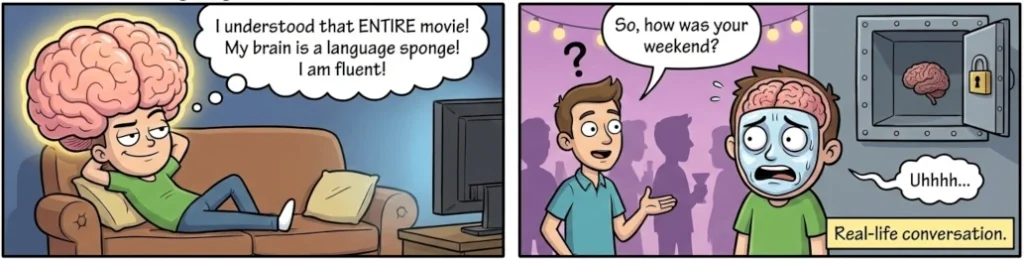
Let’s break down the real reason this happens and how to finally close the gap between understanding and speaking.
🧠 Key Insight: The brain uses different systems to understand language vs. speak it. Recognizing words isn’t the same as being able to produce them.
Recognition vs. Production: The Core Divide
Comprehension = Recognition
You can recognize words, grammar, and meaning based on:
- Context clues
- Familiar patterns
- Visual/auditory cues
It’s passive — your brain receives language and decodes it.
Speaking = Production
You must actively:
- Select words
- Use correct grammar
- Recall pronunciation
- Coordinate speaking muscles
- Respond in real-time
It’s active — your brain creates language from scratch.
🔬 Science Says: These two processes are handled in different brain regions (leonardoenglish.com).
Why Your Brain Understands Faster Than It Speaks
Recognition is Fast and Forgiving
You don’t need to know every word to get the meaning.
Your brain fills in the gaps based on:
- Familiar sounds
- Story context
- Visuals
Speaking is Slow and Risky
You can’t guess your way through speaking. You have to:
- Recall the right word
- Choose the correct tense
- Say it out loud — and quickly!
This is where many learners freeze — not because they’re bad at the language, but because their output system is undertrained.
🧪 Brain Fact: It takes more mental energy to produce speech than to recognize it (bcbl.eu).
Brain Architecture: Different Pathways for Input & Output
Neurolinguistics shows this clearly:
| Function | Brain Area | Role |
|---|---|---|
| Understanding | Wernicke’s Area | Interprets meaning from words and sentences |
| Speaking | Broca’s Area | Builds and outputs sentences; coordinates muscles to speak |
When you understand a word, you may only be activating Wernicke’s area. To speak it, Broca’s area must also be involved — and it needs practice to get fast.
Why You “Know” Words But Can’t Recall Them
Let’s say you’ve heard the word “improve”. You recognize it instantly. But when you try to say it in a sentence… nothing.
That’s because recognition does not build retrieval pathways.
🧠 Neuroscience Fact: Repeated active recall is what builds the ability to speak spontaneously.
Understanding ≠ Readiness.
You can know what a word means but still struggle to use it — unless you’ve practiced using it in speaking or writing.
Affective Filters: Why Fear Makes You Forget Words
Even if you know the words, social pressure can block access.
Language learners often experience:
- Fear of mistakes
- Anxiety about pronunciation
- Pressure to respond quickly
This activates the amygdala, the brain’s fear center, which can shut down access to the language you already know.
🧠 Language Theory: Krashen’s “Affective Filter Hypothesis” explains this — emotional states affect how much of your language knowledge you can access (cvc.cervantes.es).
Practical Payoff: How to Turn Understanding Into Speaking
Here’s how to finally speak what you already understand — with science-backed exercises that train your production system:
✅ 1. Shadowing (30–60 seconds/day)
Listen to a native speaker and immediately repeat everything — same tone, speed, and emotion.
🧠 Why it works: Trains pronunciation + speeds up neural access to known words.
🛠 Use it with: Podcasts, YouTube clips, or Aprelendo.
✅ 2. Quick Recall Drills
Use cue cards to trigger fast responses. For example:
- “What did you do today?” → Answer in 5 seconds
- “Describe a movie in 3 words” → Say it fast
🧠 Why it works: Builds retrieval strength under time pressure.
🛠 Try it using Aprelendo’s Study, which gives you daily flash cards.
✅ 3. Output-Only Days
Set one day per week where you:
- Speak out loud (to yourself or others)
- Write summaries in the target language
- Do everything you normally do… but only in your L2
🧠 Why it works: Immersion forces deeper brain engagement.
✅ 4. Record Yourself
Talk about your day for 1 minute. Listen back and notice:
- Pauses
- Word gaps
- Repeated errors
Then re-record and improve.
🧠 Why it works: Feedback sharpens both fluency and confidence.
✅ 5. Conversation with Correction
Speak with a tutor or partner who stops you just enough to correct and guide — not interrupt flow.
🧠 Why it works: Real conversations + immediate feedback = the fastest production booster.
The Aha! Moment: Speaking Is Just a Trainable Skill
The reason you understand more than you speak isn’t a mystery anymore.
It’s because:
- Recognition develops faster than production
- Your brain’s output systems need repetition
- Fear and perfectionism block recall
But here’s the good news:
💡 Fluent speaking is not a talent, it’s a trainable, scientific process.
And every time you speak (even imperfectly), you build the brain pathways that make the next sentence easier.
🎯 Ready to speak what you understand? Start training your speaking brain with Aprelendo →
Leave a Reply