If you’ve ever tried learning a language through reading, you’ve probably had one of two experiences.
Either the text feels too easy and boring, or it’s so difficult that every sentence requires a dictionary.
Both slow you down.
The real question isn’t “Should I read when learning a language?” The research is clear—reading is one of the most powerful tools for language acquisition.
The real question is this:
What kind of reading text actually helps you learn faster?
Your brain doesn’t learn efficiently from random difficulty. It learns from structured challenge—material that pushes you just enough without overwhelming you.
Let’s break down the science behind what makes a reading text truly effective for language learners.
The “Sweet Spot”: Why Difficulty Matters More Than You Think
Language learning works best when your brain can predict meaning while still encountering new information.
If a text is too easy, your brain goes on autopilot. No learning happens.
If it’s too hard, your brain switches into survival mode and focuses on decoding instead of absorbing.
This idea is well known in linguistics: learning accelerates when input is just slightly above your current level.
In practice, that means:
- You understand 80–95% of the words
- You can follow the story or argument
- Unknown words are guessable from context
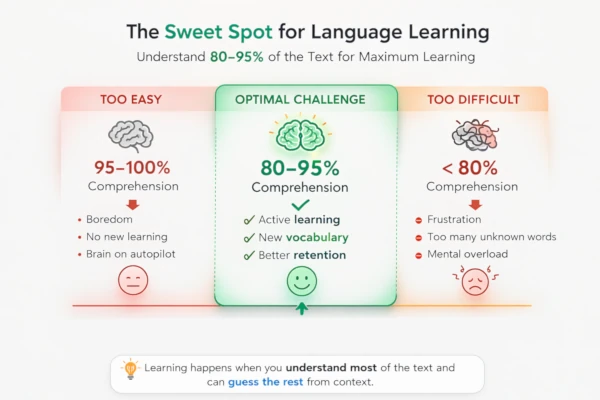
Your brain learns best when it can infer meaning rather than constantly translate.
That inference process strengthens vocabulary networks and improves reading fluency.
So when choosing a reading text, ask yourself one simple question:
Can I understand most of this without a dictionary?
If the answer is yes, you’re in the learning zone.
Why Context Beats Vocabulary Lists
Many learners try to memorize vocabulary before reading.
It feels productive, but it’s actually backwards.
Your brain stores words more efficiently when they’re tied to meaningful context.
Think about how you learned your first language. Words didn’t appear on flashcards—they appeared inside stories, conversations, and situations.
The same mechanism still works.
When a word appears in context, your brain processes:
- The word itself
- The surrounding grammar
- The emotional or narrative meaning
This creates multiple memory connections, which dramatically improves retention.
That’s why good reading texts contain repeated vocabulary across meaningful situations.
Instead of seeing a new word once, you encounter it naturally multiple times.
And each encounter strengthens recall.
The best reading materials don’t teach vocabulary directly—they make vocabulary unavoidable.
Why Stories Work Better Than Random Text
Not all reading materials are equal.
A list of disconnected paragraphs won’t activate your brain the same way a story does.
Your brain is wired to process narratives.
Stories activate prediction, emotion, and curiosity—all of which improve learning.
When you read a narrative, your brain constantly asks:
- What happens next?
- Why did the character do that?
- What problem will appear next?
This prediction loop keeps your attention engaged.
And attention is the real fuel of learning.
That’s why language learners often remember vocabulary from stories much better than from textbooks.
Emotion + curiosity = stronger memory encoding.
Even simple stories create this effect.
The key isn’t complexity—it’s engagement.
So a good reading text should have:
- A clear storyline
- Characters or situations
- A natural progression of events
When reading feels like following a story instead of studying grammar, your brain stops resisting the process.
The Hidden Power of Repetition (Without Boredom)
One of the biggest drivers of language learning is repeated exposure.
But repetition only works when it feels natural.
Good reading materials repeat key words and structures without sounding repetitive.
For example, a story about travel might naturally repeat:
- airport
- ticket
- flight
- hotel
- passport
These words appear across multiple scenes, reinforcing vocabulary while keeping the story moving.
Your brain loves this pattern.
Each repetition strengthens neural connections, but because the context changes slightly, the repetition doesn’t feel mechanical.
This is why graded readers and structured learning content often outperform random online articles.
They’re intentionally designed to recycle vocabulary across chapters.
Learning accelerates when the same language appears again in new situations.
Why Shorter Texts Often Work Better
Many learners think longer texts are better for immersion.
In reality, shorter, focused texts often produce faster progress.
Why?
Because cognitive overload is real.
When a text is too long, your working memory becomes saturated. Instead of learning new words, your brain focuses on simply finishing the text.
Short texts allow you to:
- Read more attentively
- Notice patterns in grammar
- Re-read sections easily
Re-reading is especially powerful.
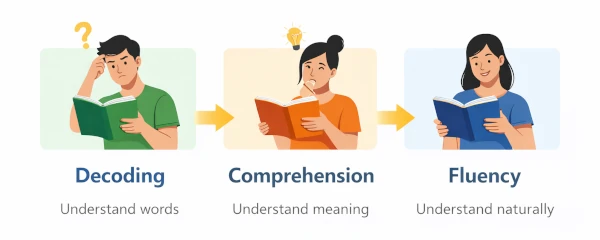
The first time you read a text, your brain decodes.
The second time, it notices vocabulary.
The third time, it processes grammar automatically.
Each pass deepens comprehension without extra effort.
That’s why many effective language-learning systems use short, dense reading passages instead of long chapters.
The Key Ingredient Most Learners Miss: Enjoyment
This might sound simple, but it’s one of the most important factors.
If you don’t enjoy the text, you won’t read enough.
And language learning is ultimately a volume game.
The more meaningful input your brain receives, the stronger your language system becomes.
So the best reading material isn’t just level-appropriate.
It’s also interesting.
That could mean:
- Short stories
- Cultural anecdotes
- Travel narratives
- Dialogue-based texts
When reading becomes something you look forward to instead of something you “should” do, consistency takes care of itself.
And consistency is where fluency really grows.
The best learning material doesn’t feel like studying—it feels like discovery.
Turning Good Theory Into Daily Practice
Understanding these principles is powerful.
But applying them consistently is what actually builds fluency.
The most effective reading materials follow a simple formula:
- Slightly challenging but mostly understandable
- Story-driven and engaging
- Rich in contextual vocabulary
- Designed with natural repetition
- Short enough for focused reading
When these elements work together, your brain learns almost automatically.
That’s the philosophy behind tools like the Aprelendo app.
Instead of random texts, the platform is designed to deliver reading material that matches how the brain actually acquires language—contextual vocabulary, natural repetition, and engaging content.
In other words, it automates the logic we just explored.
Because language isn’t meant to be memorized in isolation.
It’s meant to connect people, ideas, and cultures.
And the right reading text is one of the most powerful bridges you can build.
Leave a Reply