You watch a video in your target language, understand enough to enjoy it, then finish with the uneasy sense that you did not really study. Or you try to study it properly, pause every few seconds, open a dictionary ten times, and turn a six-minute video into an hour of work.
Both habits are understandable. Neither gives you a repeatable answer to how to learn a language with YouTube.
The useful middle ground is to give one short clip two jobs: first, let it communicate something; then use a small part of it to diagnose what you missed and collect a few expressions worth meeting again. The 20 minutes below are a design constraint, not a magic dose. Its purpose is to stop a session expanding until you avoid it.
You can still watch videos purely for pleasure. In fact, you should if that is what keeps your contact with the language regular. This is a separate loop for the occasions when you want a video to produce a little more than exposure.
Why YouTube helps, and why “just watch more” is incomplete
YouTube gives learners access to real speakers talking about real interests: repairs, recipes, football analysis, urban history, game reviews, make-up tutorials, politics, woodworking. That matters because prior knowledge, visuals and genuine interest can all make difficult language more accessible.
It is also not a classroom designed around your level. A creator may speak quickly, cut between speakers, assume cultural background knowledge, use poor audio, or upload unreliable automatic captions. If you cannot identify the subject or follow the broad point after a supported viewing, the video may be a poor fit for this session. That is a material decision, not a verdict on your ability.
Research on viewing supports a measured version of the YouTube promise. Peters and Webb’s work on L2 television found that viewing can contribute to incidental vocabulary learning, while learner and word-related factors affect what is learned. A later meta-analysis of incidental L2 vocabulary learning similarly found variation across studies and conditions rather than a guarantee that every unfamiliar item becomes known through exposure.
That is why a good routine includes both meaning-focused viewing and a short, deliberate follow-up. You preserve the reason to watch while giving a few high-value moments enough attention to become usable.
Choose a clip that gives you a fair chance
A perfectly interesting video can still be unsuitable for study today. Start by making the odds reasonable.
Begin with a narrow, familiar topic
Choose a topic you could explain in your first language. If you already know how sourdough works, a Spanish baker discussing hydration gives you visual and conceptual anchors. If you follow a particular football club, a post-match analysis supplies names, repeated terms and a predictable structure.
Broad entertainment videos can work too, but they often change topic and speaker quickly. For a first routine, a five to ten minute clip with one clear purpose is easier to work with than a forty-minute panel discussion.
Prefer one speaker, usable sound and visual support
Clear audio is not a luxury. It changes what you can learn from a transcript check. A single speaker with a visible face or demonstrable activity lets you connect sound, gesture and meaning. Fast cuts, background music and overlapping jokes are not forbidden; they simply make poor material for diagnosing word boundaries.
Also check whether the clip has target-language captions or a transcript. Captions are not always a verbatim record. Creators may paraphrase them, a video may be dubbed, and automatic captions can mishear names, dialect words and reduced speech. Treat the written track as a tool to check, not as an unquestionable script.
Use the 90-second fit test
Watch about 90 seconds without turning it into an exam. Afterwards, ask:
- Can I name the topic and the speaker’s broad point?
- Can I recognize a few repeated words or expressions?
- Do the visuals, title or my background knowledge give me anchors?
- Is there a target-language transcript or caption track I can use later?
A “yes” to most of these is enough. You do not need to understand every sentence. But if you cannot recover the main subject even after using the title and visuals, choose a more supported clip or park this one for later.
The 20-minute YouTube study loop
The order matters. Meaning comes before diagnosis. Otherwise the transcript becomes a substitute for listening and every unfamiliar word feels equally urgent.
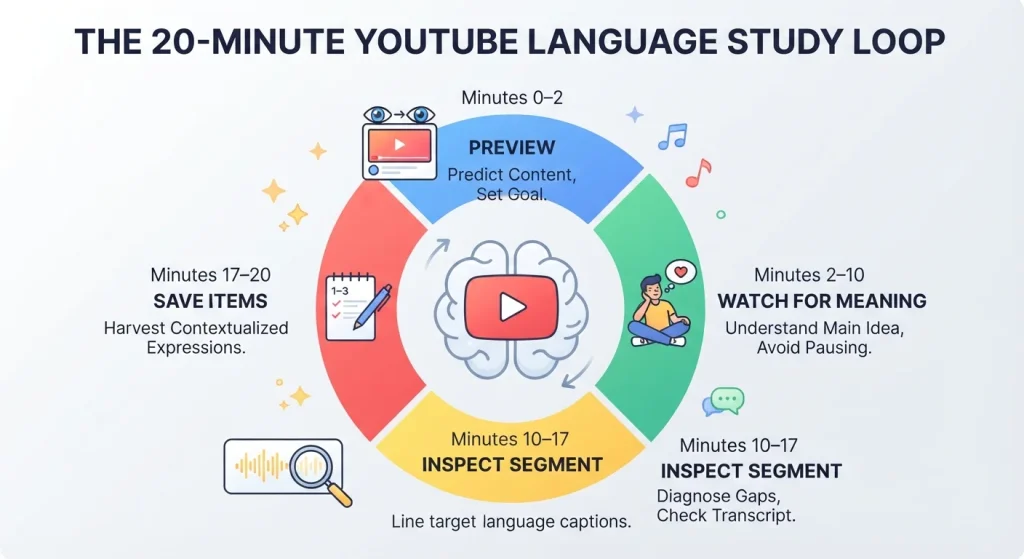
Minutes 0–2: preview before you press play
Read the title, look at the thumbnail and scan the channel description if it helps. Decide what you expect to learn from the video itself, not only from the language. For example: “I want to understand why this chef salts the aubergine first,” or “I want the presenter’s opinion on the new transport proposal.”
This small prediction gives you something concrete to listen for. It also prevents a common trap: calling a session a failure because you missed details while still understanding the point.
Choose your caption setting before watching. Target-language captions are often useful when you need help connecting speech to spelling. Native-language subtitles can make sense for a tightly bounded orientation need, especially with a dense plot or unfamiliar subject. For a fuller comparison, see Target-Language Subtitles, Native-Language Subtitles, or No Subtitles?.
Minutes 2–10: watch for meaning, with interruptions kept rare
Watch the clip, or the first manageable section of a longer one, from beginning to end. Your job is to answer the question you set in the preview and to follow the main thread.
Do not pause for every unknown word. If a word prevents you understanding the central claim, a key instruction or the turn in a story, pause once and check it. If it is colorful but nonessential, let it pass. You can return to it if it recurs. For a fuller rule, use blocker, bridge, and bonus.
Suppose a French gardening video says that a plant is rustique, then spends a minute explaining frost and winter conditions. You may be able to infer that it concerns hardiness without immediately looking it up. If rustique reappears as the reason the plant suits a balcony, it has become worth checking. The decision is based on the word’s role in this video, not on whether it is new.
At the end of the first watch, say or write a one- or two-sentence retell. Keep it plain: “She recommends starting seedlings indoors because the nights are still cold.” A retell reveals whether you followed the argument better than a vague feeling of familiarity does.
Minutes 10–17: inspect one short transcript segment
Now choose a 20 to 60 second stretch that was useful and slightly slippery. Do not inspect the whole video. The aim is to find out why you missed it.
Replay the segment once without reading. Then check the target-language transcript or captions and replay it again. Label the mismatch in simple terms:
- Unknown language: you did not know a word or phrase.
- Linked or reduced speech: you know the words on paper but did not hear their boundaries.
- A missed boundary: you divided sounds into the wrong words.
- Accent or delivery: the speaker’s pronunciation, speed or intonation hid a familiar item.
Imagine hearing Italian ce l’hanno detto ieri as an indistinct blur. The transcript may show that the problem was not four unknown words. You already knew detto and ieri; you had not yet learned to recognize the compact sequence in fast speech. Replay that one sentence a few times, then move on.
This is a better use of a transcript than reading along from the start. It makes the text answer a listening question you actually encountered.
Minutes 17–20: save no more than three contextual items
Finish with a small harvest. One recurring word, one phrase or collocation, and optionally one pattern are plenty for one clip. The cap protects you from creating a review list you will never revisit.
Save each item with enough context to make it recognizable later:
tener ganas de + infinitive — “I feel like doing…”
Hoy no tengo ganas de cocinar.
03:42, a creator explaining why she ordered takeaway after work.
The timestamp and surrounding sentence matter. A bare translation can tell you that ganas relates to desire; the clip shows the ordinary pattern you could use in conversation.
If you use Aprelendo, this is the point where its in-context lookup and saved-item review can be useful: save the relevant sense and the sentence, rather than a detached word list. The method does not depend on the app. A note, flashcard tool or document works if it preserves the phrase and its situation.
The later replay turns exposure into a listening check
Return to the same clip a few days later. Replay the short segment you studied without captions first. Can you now hear the phrase that previously disappeared? Can you retell the main point with fewer gaps?
Do not expect perfect recall. The useful signal is more modest: a sound sequence that once felt like noise begins to separate into familiar words, or a phrase becomes available when you describe a similar situation.
Repeated encounters matter because one viewing rarely produces durable command of every new item. The research literature on incidental vocabulary learning reports gains, but also substantial variation by input, learner, word and measurement. A delayed replay gives you another encounter and a clear reason to notice whether anything changed.
Use subtitles as a scaffold, not a permanent setting
The right caption setting depends on your goal for that pass.
If you need to understand a useful video well enough to stay engaged, target-language captions may be the best compromise. They can help you connect a sound you half-recognize with a spelling you know. If the point of a first watch is simply not to get lost in a dense documentary, a brief native-language subtitle pass can be sensible too.
For diagnosis, remove captions for a short replay before checking them. Audio-only viewing is most informative when you already have enough context to form a hypothesis about what was said. Starting with a full episode audio-only when you understand almost nothing mostly measures that the episode is too hard.
Dual subtitles can resolve a particular ambiguity, but keeping two languages on screen throughout divides attention. Use them briefly, then return to one language or to the audio.
Know when to pause, persist or park a video
A manageable challenge has anchors. You may miss details, but topic knowledge, visuals, repeated language or a transcript let you reconstruct the main thread. Persist with those clips.
Use transcript support when the problem is sound recognition: you understand the line after seeing it and can identify what you did not hear. If the transcript introduces a modest number of useful phrases, study a short section and save only the best ones.
Park a clip when support still does not give you a main idea. This may happen with a highly technical monologue, a conversation full of cultural references, a poor-quality upload or a speaker whose delivery is beyond your current access. Save it to revisit in a few months; do not convert it into a punishment project. If the same problem appears across materials, the intermediate-plateau diagnostic can help separate material mismatch from a listening or vocabulary bottleneck.
Common mistakes that make YouTube study exhausting
Treating channel lists as a study plan
Recommended-channel lists are useful for finding material. They do not tell you what to do after pressing play. Pick one video and use a repeatable sequence before looking for another tool or extension.
Pausing every five seconds
Constant interruption removes the message from the message-first watch. Reserve close attention for one short segment after you have tried to understand the whole.
Choosing material only because it is “native”
Native-speaker content can be an excellent resource, but authenticity alone is not a difficulty setting. A clear local-history walk may be more useful today than a native podcast with five speakers and no visual support.
Saving isolated words by the dozen
A long list may feel productive during the session and become unusable later. Save the few phrases that recur, carry the speaker’s point or fit situations you expect to meet.
Frequently asked questions
Can I learn a language just by watching YouTube?
Watching can provide meaningful exposure and may contribute to vocabulary growth, especially when you understand enough to follow content that interests you. It is not a complete answer to every goal. Speaking and writing benefit from opportunities to retrieve language and receive feedback; grammar questions sometimes need direct attention. Use YouTube as a strong source of input and listening practice, then add the practice your goal requires.
How difficult should a YouTube video be?
Choose one where you can identify the topic, recover a basic main point and recognize some repeated language with available support. There is no single speed, word-count or CEFR cutoff that works across genres and languages. A familiar topic with visuals can be more accessible than an apparently simpler video with no context.
Should I use target-language or native-language subtitles?
Choose by the job of the viewing pass. Target-language captions help with sound-to-spelling mapping and language noticing. Native-language subtitles are useful when they solve a defined orientation problem. A later short audio-only replay tests what you can understand by ear. Read the full caption-setting guide before treating any one option as a rule.
How many videos should I study each week?
Choose a frequency you will revisit. Two short clips studied and replayed can teach you more about your listening gaps than seven clips watched once under pressure. Keep pleasure viewing separate from deliberate sessions so the routine does not make all entertainment feel like homework.
Make the next clip small enough to finish
Pick one five- to ten-minute video on a topic you already care about. Do the 90-second fit test, watch for its main point, inspect one slippery 20- to 60-second segment, and save at most three items with context. Put a reminder in your calendar to replay that segment later in the week.
That is enough for a first session. The goal is not to extract every possible lesson from YouTube. It is to make one real piece of language understandable now and a little easier to hear next time.
Sources
- Peters, E., & Webb, S. (2018). Incidental vocabulary acquisition through viewing L2 television and factors that affect learning. Studies in Second Language Acquisition, 40(3), 551–577. https://doi.org/10.1017/s0272263117000407
- Uchihara, T., Webb, S., & Yanagisawa, A. (2023). How effective is second language incidental vocabulary learning? A meta-analysis. Language Teaching, 56(2), 161–180. https://doi.org/10.1017/s0261444822000507
Leave a Reply