
Fluency is the goal most language learners care about—but it’s also the hardest to define.
People often assume fluency comes from memorizing grammar rules or practicing speaking for hours. Those help, but applied linguistics consistently shows that one of the most powerful drivers of fluency is something much simpler: reading a lot.
This approach is called extensive reading—reading large amounts of easy, interesting material in the target language.
And the evidence behind it is surprisingly strong.
Let’s break down why extensive reading works and how you can use it to accelerate your fluency.
What Extensive Reading Actually Means
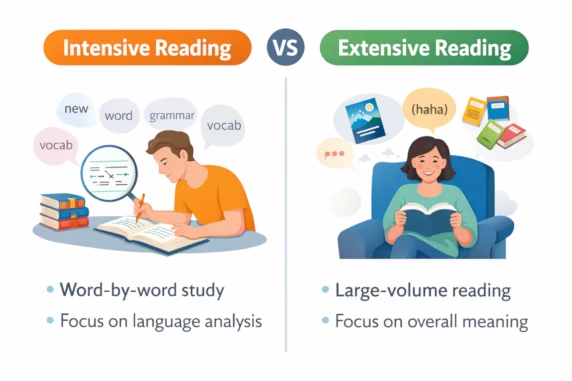
Extensive reading isn’t studying texts word by word.
It’s the opposite.
Instead of analyzing language, you consume it naturally, much like how people read novels, blogs, or comics in their native language.
Key characteristics include:
- Material is easy enough to understand
- You read large quantities
- The focus is on meaning, not translation
- You choose content that genuinely interests you
The logic is simple: fluency grows from exposure.
Your brain needs thousands of examples of how words and structures appear in real contexts.
Extensive reading provides exactly that.
Why Your Brain Learns Faster Through Context
Your brain is designed to detect patterns.
When you read a lot, you repeatedly encounter the same vocabulary, sentence structures, and grammatical patterns. Over time, your brain begins recognizing these patterns automatically.
This process builds implicit knowledge—the kind you use when speaking without consciously thinking about rules.
That’s the difference between:
- Knowing a rule
- Using language effortlessly
Applied linguistics consistently shows that implicit knowledge drives fluency far more than explicit grammar knowledge.
Extensive reading feeds that system.
Instead of memorizing isolated words, you absorb how language behaves in real situations.
For example, after seeing phrases like:
- “make a decision”
- “take responsibility”
- “come to a conclusion”
…your brain naturally learns common collocations without needing to study them directly.
Fluency is essentially pattern recognition at speed.
Reading massively trains that skill.
How Vocabulary Growth Explodes With Reading
Vocabulary acquisition is one of the strongest benefits of extensive reading.
Why?
Because language learning relies heavily on repeated encounters with words in context.
Research in applied linguistics shows that a learner typically needs multiple exposures to a word before it becomes part of active vocabulary.
Extensive reading makes those repetitions happen naturally.
For example, imagine encountering the word “challenge.”
You might see it in contexts like:
- “This project is a challenge.”
- “She challenged the idea.”
- “The company faces new challenges.”
Each exposure builds a richer mental understanding.
Instead of memorizing dictionary definitions, you develop a network of meanings and uses.
And here’s the key insight:
Vocabulary depth—not just vocabulary size—is what drives fluency.
The more contexts you see a word in, the faster you can access it while speaking.
The Fluency Loop: Input Fuels Output
Many learners focus heavily on speaking practice.
Speaking is important—but it depends on input.
Think of language as a database in your brain.
If the database is small, your output is limited.
Extensive reading massively expands that database.
Here’s how the fluency loop works:
- You read large amounts of comprehensible text
- Your brain absorbs vocabulary and sentence patterns
- Those patterns become automatic
- Speaking becomes faster and smoother
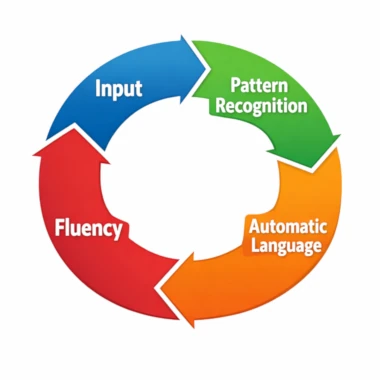
Input builds the raw material for output.
Without it, learners often experience the “speaking plateau,” where they can communicate but struggle to sound natural.
Extensive reading helps break that plateau because it exposes you to authentic phrasing and rhythm.
You start thinking in chunks instead of translating word by word.
And that’s a major step toward real fluency.
Why “Easy Reading” Is the Secret Weapon
One surprising principle from applied linguistics is this:
Reading slightly easier material produces better learning than reading difficult texts.
This happens for two reasons.
First, comprehension stays high.
Second, reading speed increases dramatically.
When you read faster, you get more exposure per hour.
More exposure means more pattern recognition.
That’s why extensive reading programs recommend material where you understand around 90–98% of the words.
At that level, you can focus on the story instead of constantly stopping to look things up.
This creates a powerful learning environment where:
- reading feels enjoyable
- motivation stays high
- language exposure skyrockets
And motivation matters.
The brain learns far better when curiosity and enjoyment are involved.
How to Start an Effective Extensive Reading Habit
The biggest mistake learners make is choosing books that are too difficult.
Start simpler than you think you need.
Good options include:
- graded readers
- short stories
- comics and graphic novels
- blogs and online articles
- children’s literature
The goal is volume and consistency.
Try this structure:
Step 1 — Read 15–20 minutes daily
Consistency beats long, occasional sessions.
Step 2 — Avoid constant dictionary use
If a word isn’t critical, skip it.
Step 3 — Follow your interests
Interest increases attention, and attention improves memory.
Step 4 — Track reading quantity, not perfection
Fluency grows from exposure, not accuracy.
Within weeks, most learners notice something interesting:
They start recognizing phrases automatically.
And that’s the brain adapting.
Why Extensive Reading Aligns With Real Language Use
Language isn’t just grammar—it’s connection.
People use language to share ideas, tell stories, and understand each other.
Extensive reading immerses learners in those real communicative contexts.
You’re not just learning rules.
You’re experiencing how language carries meaning, emotion, and culture.
That’s why reading stories, articles, and conversations feels so powerful.
You’re engaging with language the way native speakers do.
And once that happens, fluency stops feeling like a technical skill and starts feeling like participation in a global conversation.
Turning Reading Into a Fluency Engine
The science is clear:
Large amounts of understandable input are one of the fastest ways to build fluency.
Extensive reading works because it:
- strengthens pattern recognition
- builds vocabulary naturally
- develops implicit grammar knowledge
- feeds the brain the input it needs for smooth output
But the biggest advantage is sustainability.
When reading becomes enjoyable, learning stops feeling like work.
And that’s exactly the philosophy behind the Aprelendo approach to language learning.
Instead of forcing memorization, the app is designed to automate the same principle that makes extensive reading effective—frequent, meaningful exposure to real language.
Think of it as a tool that keeps the fluency loop running.
Because at the end of the day, fluency doesn’t come from knowing more rules.
It comes from seeing and experiencing language so often that using it becomes natural.
Leave a Reply