
If you are learning a language, you have probably heard two pieces of advice that seem to contradict each other.
Some teachers say: read silently as much as possible. Others insist: read aloud to improve pronunciation and speaking skills.
So which method actually works better?
The short answer is that both have value — but they train different aspects of language ability. Understanding how each one works can help you choose the right approach at the right moment in your learning process.
What Happens When You Read Silently
Silent reading is the most common way people read in their native language. When you read silently, your brain processes meaning directly from the written words without needing to produce sound.
Research in applied linguistics shows that silent reading is especially powerful for developing fluency and vocabulary recognition. Because you are not spending time articulating every word, you can read faster and expose yourself to much more language.
This large amount of exposure is crucial.
Language acquisition depends heavily on input — seeing words and structures many times in meaningful contexts. Silent reading allows learners to accumulate this input efficiently.
Over time, the brain begins to recognize words and patterns automatically. This process is sometimes called automaticity, and it is one of the key ingredients of fluent reading.
In other words, silent reading helps your brain move from slow decoding to effortless comprehension.
What Happens When You Read Aloud
Reading aloud activates a different set of skills.
When you read aloud, you must convert written text into spoken language. This requires coordinating several processes at once:
- recognizing the word
- retrieving its pronunciation
- producing the sounds with your voice
- maintaining the rhythm and intonation of the sentence
Because of this, reading aloud is particularly useful for developing phonological awareness — the ability to connect spelling with pronunciation.
This can be very helpful for languages with unfamiliar sound systems or irregular spelling. Reading aloud forces learners to notice details that silent reading might skip over.
It also trains articulation and speech rhythm, which are essential for speaking.
However, reading aloud is slower and cognitively heavier. The effort required to produce speech means learners often focus more on pronunciation than on meaning.
For that reason, reading aloud is usually less effective for developing reading fluency or overall comprehension.
What Research Suggests
Studies comparing silent reading and oral reading generally find that silent reading is more effective for building reading speed, vocabulary growth, and comprehension, especially when learners read large amounts of interesting material.
This approach is often called extensive reading.
However, research also shows that reading aloud can be valuable in specific contexts:
- when practicing pronunciation
- when learning the sound system of a new language
- when preparing for speaking activities
- when working with short, carefully chosen texts
In other words, the two techniques serve different purposes.
A Simple Way to Combine Both
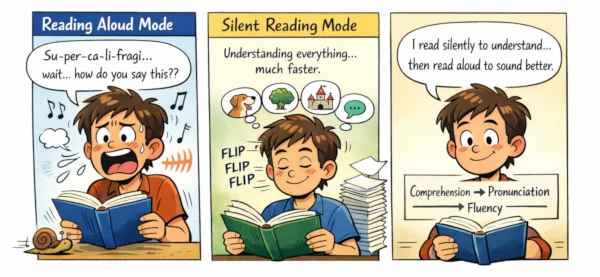
Instead of choosing one method over the other, many language learners benefit from combining them.
A useful pattern looks like this:
- Read silently first to understand the text and build comprehension.
- Read aloud afterward to practice pronunciation and rhythm.
This sequence mirrors how fluent readers process language: meaning first, sound second.
It also prevents a common problem where learners focus so much on pronouncing words that they lose track of the message.
The Most Important Factor: Volume
Regardless of the method you choose, the most important factor is how much you read.
Language learning research consistently shows that progress depends heavily on exposure. The more words, sentences, and stories your brain encounters, the more patterns it learns.
Silent reading is particularly effective for achieving this volume because it allows you to move quickly through large amounts of text.
Reading aloud, on the other hand, works best as a focused exercise on smaller passages.
The Bottom Line
Silent reading and reading aloud are not competing methods. They simply train different abilities.
Silent reading builds speed, comprehension, and vocabulary. Reading aloud strengthens pronunciation and speech rhythm.
The best approach is to use each technique for what it does best — and above all, to read often.
Because in language learning, every page you read is another step toward fluency.
Leave a Reply