
Flashcards feel like the ultimate study hack. Simple, portable, and proven. But here’s the real question most people don’t ask:
Does making flashcards help you learn—or is it just busywork?
Cognitive psychology gives a surprisingly nuanced answer. It’s not a simple yes or no. It depends on how you make them—and whether you’re using your brain the way it’s designed to learn.
Let’s break it down.
The Hidden Benefit: Why Making Flashcards Can Boost Learning
At first glance, writing your own flashcards seems like extra effort. But that effort is actually the point.
Your brain remembers what it has to work for.
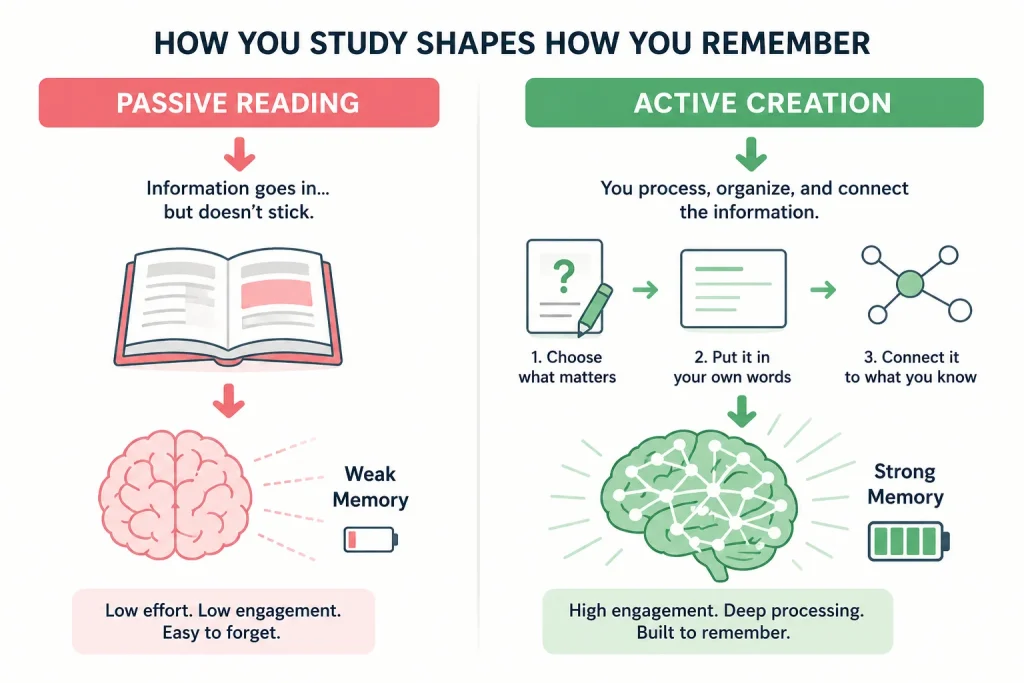
When you create flashcards yourself, you’re not just copying information—you’re making decisions:
- What’s important?
- How should I phrase this?
- What’s the simplest way to explain it?
That process activates what’s known in learning science as deep processing. Instead of passively reading, you’re transforming the material.
And transformation = stronger memory.
Why This Works
- You engage retrieval pathways while deciding what to include
- You simplify complex ideas (which forces understanding)
- You connect new knowledge to what you already know
In short: making flashcards can turn studying into thinking—and thinking is what sticks.
The Catch: When Making Flashcards Becomes a Waste of Time
Here’s where things go wrong.
Not all flashcard-making is equal.
If you’re just copying sentences from a textbook word-for-word, you’re not learning—you’re transcribing.
Your brain treats that like low-effort activity, similar to scrolling.
Common Mistakes That Kill the Benefit
- Writing overly long definitions
- Copying instead of summarizing
- Making too many cards without reviewing them
- Focusing on aesthetics (colors, handwriting) instead of clarity
The result? You spend hours “studying” but retain almost nothing.
This is a classic trap: it feels productive, but it’s cognitively shallow.
The Real Power Move: Retrieval Practice Beats Creation
Here’s the key insight most people miss:
Flashcards work best not when you make them—but when you use them.
This taps into one of the most powerful learning principles: retrieval practice.
Every time you try to recall an answer before flipping the card, you’re strengthening memory pathways.
It’s like doing reps at the gym—but for your brain.
Why Retrieval Works So Well
- It forces your brain to reconstruct knowledge
- It reveals gaps in understanding
- It strengthens long-term retention
In fact, testing yourself is often more effective than re-reading or rewriting notes.
So if making flashcards cuts into the time you could spend using them, it can actually hurt your learning.
So… Should You Make Your Own Flashcards?
Here’s the pragmatic answer:
Yes—if you do it strategically. No—if it replaces actual practice.
Think of flashcard creation as a tool, not the goal.
When You SHOULD Make Your Own Flashcards
- You need to simplify complex concepts
- You’re learning material that requires understanding (not just memorization)
- You can keep cards short and focused
- You’ll actually review them consistently
When You Should NOT
- You’re short on time and need quick practice
- Pre-made flashcards already exist and are high-quality
- You tend to overcomplicate or over-design your cards
The golden rule: If making flashcards takes longer than using them, you’re doing it wrong.
A Smarter System: Combine Creation + Retrieval
The best approach isn’t choosing one or the other—it’s combining both in a lean way.
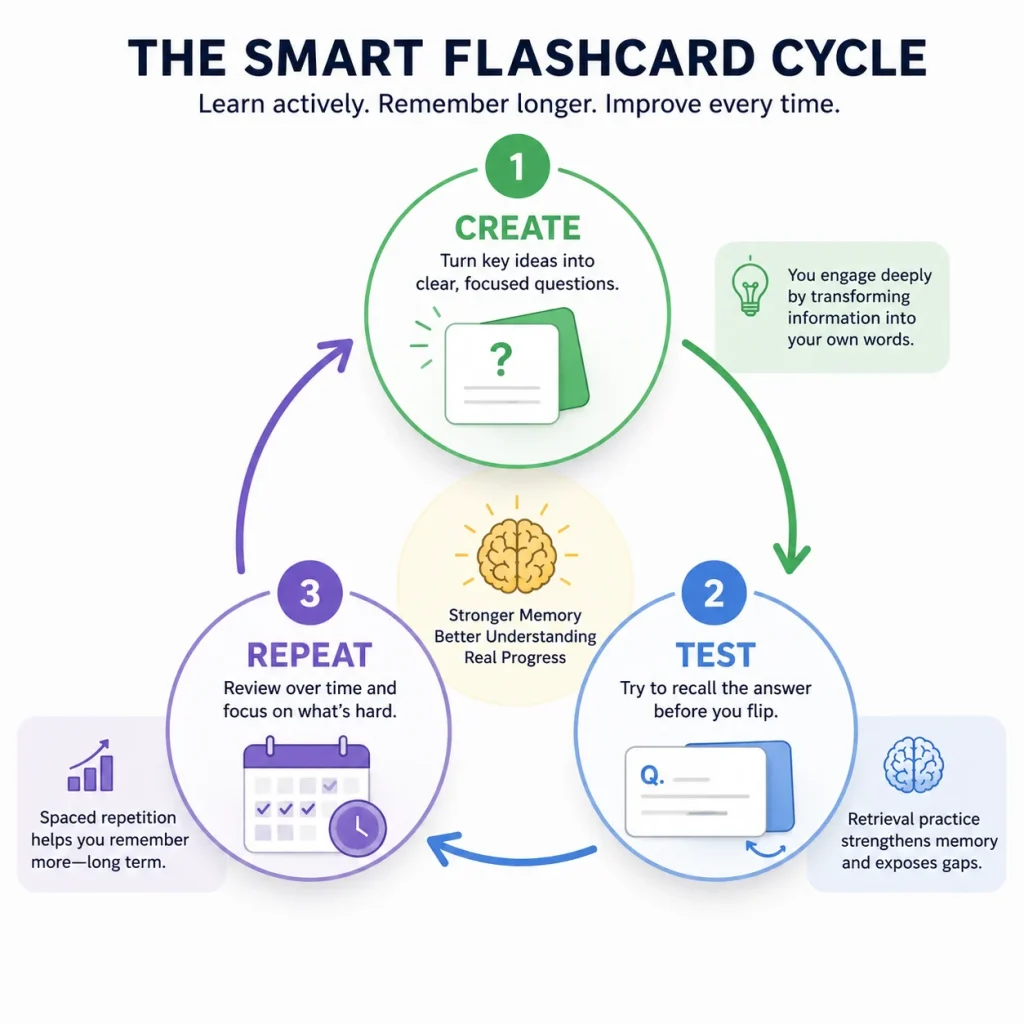
Here’s a simple system that aligns with how your brain actually learns:
Step 1: Create (Lightly)
- Turn key ideas into questions
- Keep answers short (1–2 lines max)
- Use your own words
Step 2: Test Yourself
- Look at the question
- Try to recall the answer fully
- Only flip when you’ve committed
Step 3: Space It Out
- Review cards over multiple days
- Focus more on difficult cards
This blends deep processing with retrieval practice—a powerful combo.
The Bigger Picture: Flashcards Are About Connection, Not Memorization
It’s easy to think flashcards are just about cramming facts.
But at their best, they’re something deeper.
They help you build connections—between ideas, languages, and real-world meaning.
This is especially true when learning a language.
You’re not just memorizing words—you’re building bridges between concepts, cultures, and conversations.
That’s why the way you engage with flashcards matters more than the tool itself.
Where Tools Fit In (Without Wasting Your Time)
Let’s be honest: manually making hundreds of flashcards isn’t always realistic.
This is where smart tools come in—not to replace thinking, but to automate the busywork.
A well-designed system (like the Aprelendo app) focuses on:
- Prioritizing what you’re about to forget
- Encouraging active recall
- Reducing time spent organizing
In other words, it handles the logistics so you can focus on the learning.
And that’s the real goal.
Final Verdict: Make Them—But Make Them Count
So, should you make your own flashcards?
Yes—if you use the process to think.
No—if you use it to avoid thinking.
That’s the line.
Flashcards aren’t magic. They’re just a structure.
What makes them powerful is how you use them:
- Actively, not passively
- Strategically, not obsessively
- Consistently, not occasionally
If you get that right, you’re not just memorizing faster.
You’re learning in a way your brain is built for.
Leave a Reply