
You have the ebook and audiobook open, but one question keeps getting in the way: should you read first, listen first, or press play while following every line?
The usual answer, “do both,” is incomplete. Reading while listening can be useful, especially when you need to connect a passage you mostly understand on the page with the way it sounds. But it can also let your eyes do all the work. Then the audio feels comprehensible only because the text is carrying it.
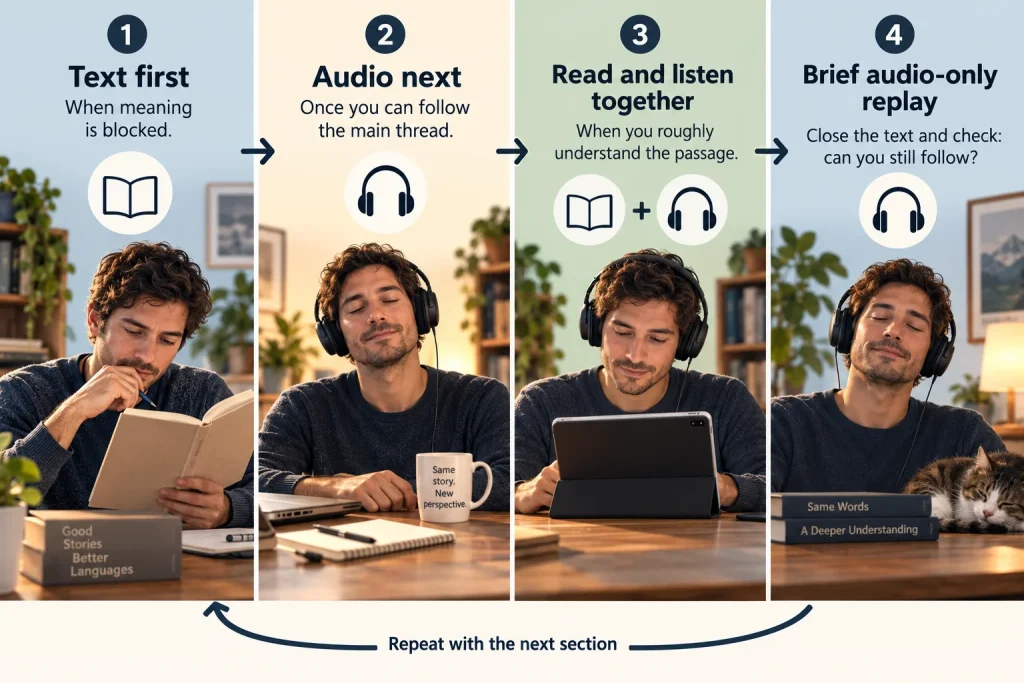
A better approach is to choose the first mode by the problem in front of you: use text when meaning is blocked, audio when you want an honest listening check, and simultaneous reading and listening when you are ready to map a roughly familiar passage between print and sound. Then do a brief audio-only replay.
Choose the first mode by the problem you are solving
Use one short, matched unit: a few paragraphs of an ebook and its audiobook, a narrated article with its text, or a podcast episode with a reliable transcript. You are not choosing a permanent learning style. You are choosing the next useful pass.
| If your main obstacle is… | Start with… | Then use… |
|---|---|---|
| You cannot follow the meaning, syntax, or references on the page | Text first | Audio after you can follow the main thread |
| You know the topic and much of the vocabulary, but audio disappears too quickly | Audio first | Text to locate what you missed |
| You roughly understand the passage but cannot reliably connect its printed and spoken forms | Simultaneous reading and listening | A short audio-only replay |
This is why advice about reading while listening for language learning needs some context. In a 2024 within-participant study, 46 English learners read, listened to, and read while listening to two versions of a fictional text. The researchers found better comprehension in the read-while-listening condition than in listening alone, but that does not make simultaneous mode the best opening move for every learner or every goal. The study’s design and findings are useful reminders that the value of the two modes depends on what is being compared.
What simultaneous reading and listening can do well
It gives sound a place on the page
When you read and listen to the same passage, you can notice how a phrase that looked simple turns into a continuous stretch of sound. A name, a familiar verb form, or a short connector may become recognizable because you see where it belongs while you hear it.
That makes dual mode a sensible bridge after you have enough of the message to stay oriented. You are not trying to absorb every syllable. You are matching useful phrases, sentence rhythm, and punctuation to the voice.
A study of 148 Japanese university freshmen in an online extensive-reading course is relevant here, but only in a limited way. It examined learners’ experience and attitudes toward audio-assisted reading over an academic year, rather than proving that the method works equally well for every learner or material. When students could choose, 47% chose to listen while reading; many saw it as useful practice, while some found parts of the experience bothersome. The paper on learners’ experience with audio-assisted extensive reading is a good reason to treat the format as an option that needs to fit the reader, not a requirement.
It can hide a listening gap
Following the words with your eyes can feel satisfying. It may also conceal the fact that you would not recognize the same phrase without the page in front of you.
That is not a reason to avoid text support. It is a reason to test what the support did. After a short simultaneous pass, close or minimize the text for 20 to 40 seconds. Can you still follow the gist? Can you recognize the phrase that had blurred together? If not, you have found a listening task worth revisiting, not a failure.
It does not replace ordinary reading or listening
Matched text and audio ask for focused attention. They work best as a small part of a broader routine that still includes reading for enjoyment and listening that is not constantly paused or analyzed.
For an introduction to reading for enjoyment at volume, see How to Skyrocket Fluency: The Hidden Power of Extensive Reading.
Start text-first when meaning is the bottleneck
Choose text first when the passage itself is hard to understand. Perhaps an essay has long sentences with several pronouns, a novel has shifted scenes, or an argument depends on a word whose meaning you cannot infer. Audio will not become useful listening practice if you have no stable idea what is being said.
Read a manageable stretch for the main thread. Do not turn the page into a dictionary exercise. Look up a word or expression when it blocks the sentence, keeps recurring, or matters to the passage’s point. Leave low-value details alone for now.
For a fuller rule for choosing which unknown items to check, see our guide to selective dictionary lookup.
Then listen to the same section. The goal has changed: you are checking how known meaning arrives in sound. Notice a phrase or two that is hard to catch, but resist making a full transcript of the chapter.
A text-first example
Imagine you are reading a narrated magazine article about a city council vote. The first paragraph contains a dense sentence about a proposal being postponed after a committee recommendation. On the page, you can work out who did what and why. That is the right moment to play the audio.
You may find that the sentence is still hard to follow at normal speed. That is useful information. Meaning was one obstacle; real-time recognition is another. Text-first did not solve listening by itself, but it gave you a clearer target for the next pass.
Start audio-first when you need a listening diagnosis
Choose audio first when the topic is familiar and the passage is short enough that you can tolerate some uncertainty. A two-minute section of a familiar audiobook chapter is better than an entire new chapter full of names and plot changes.
Listen once for the message. Make a tiny note only where the sound breaks down: “missed the reason for the decision” or “lost the phrase after the speaker’s name.” Then check the text.
This order tells you something that text-first cannot. If the printed words look familiar but the audio did not, the issue may be recognition, pacing, an accent, or the way words run together in connected speech. If the text is also confusing, you may have a vocabulary or meaning problem instead.
Do not turn this article into a fast-speech repair session. If the same kind of missed stretch keeps appearing, use a short transcript comparison to find out what you heard, what was actually said, and why the two differed.
An audio-first example
Suppose you listen to a familiar detective novel and understand that a character is leaving the station, but you miss why. The text reveals a phrase you know, “as soon as the rain lets up,” but you did not segment it in the audio. That is a sound-recognition issue. Read and listen to that sentence together once, then replay it without the text.
Use simultaneous mode after you have a foothold
Simultaneous mode is most useful when the passage is already roughly accessible. You can follow the basic story or argument, but you want to make print and sound line up more reliably.
Pick a short section and keep a single purpose in mind. You might be listening for how dialogue tags disappear into the sentence, how a speaker groups an argument into phrases, or how a recurring name sounds in a particular accent. Follow the text at the pace of the recording. If you are racing your eyes ahead of the narration, the passage is probably too easy for this task or the unit is too long.
A simultaneous-mode example
You can understand a short narrated history passage when you read it and mostly follow it when you listen. Several place names and a repeated phrase still sound unfamiliar. Read and listen to 90 seconds together, paying attention to those items. Then replay the final 30 seconds with the page closed. If the names and phrase now stand out, the mode did its job for that passage.
Use a three-pass method instead of leaving both modes on indefinitely
A short sequence gives reading while listening a clear purpose and a stopping point.
Pass 1: Choose one mode and one goal
Spend two to five minutes with a passage that is short enough to hold in mind. Choose one goal: understand the main meaning, test your audio comprehension, or map a known passage from print to sound.
Pass 2: Use the other mode as targeted support
After text-first, listen to test how the known passage sounds. After audio-first, consult the text only where the meaning or wording broke down. Use simultaneous mode after you have enough access to benefit from the mapping.
A narrated article and its transcript may not match word for word. An editor may have revised the text, a narrator may omit a sentence, or a transcript may contain errors. Compare a short area and treat a mismatch as a practical constraint, not proof that you misheard.
Pass 3: Replay a small section with audio only
Remove the text for 20 to 40 seconds. Check the gist and one or two phrases you worked on. This pass is not an exam. It simply prevents print-supported comprehension from being mistaken for independent listening.
Use a stop rule when you are only eye-tracking
Stop dual mode when you notice that you are moving your eyes across the page while the voice has become background sound. More time in that state is unlikely to resolve a mismatch between the task and the material.
Instead, change one variable:
- Shorten the unit to one paragraph or 60 to 90 seconds.
- Switch to audio-first and use the text only to check missed spots.
- Switch to text-first if you do not have enough meaning to follow the audio.
- Save the passage for later and choose something with a clearer anchor.
The same rule applies when a chapter is too dense. More support is not always the answer. Often the smaller unit is.
Build a routine that leaves room for enjoyment
A workable week might include ordinary reading or listening on most days, plus two short matched-text sessions. For example, read a novel for pleasure on three evenings, listen to its audiobook during a walk on two days, and use a four-minute excerpt with the three-pass method twice during the week.
The point is not to hit a prescribed dosage. It is to keep close reading and close listening from swallowing the material you enjoy. If you save language from a passage, favor a phrase that helped you understand or that you expect to meet again. A tool such as Aprelendo can be useful for looking up that phrase in context and reviewing a small collection over time; it does not need to be the center of the routine.
FAQ
Is it better to read first or listen first in a foreign language?
Read first when meaning, syntax, or references are blocking you. Listen first when you want to find out what you can recognize by ear. If you already understand most of the passage, read and listen together to connect the printed and spoken forms.
Does reading along with an audiobook improve listening?
It can help you connect sound with text in a passage you can already partly follow. It does not show, by itself, that you will understand the same material without text. Add a short audio-only replay to check.
Should I follow every word with my eyes?
No. Follow closely enough to stay with the voice and notice the phrases you chose to map. If you are scanning ahead or mechanically tracking every word, shorten the section or use a different first pass.
Can I use a podcast transcript instead of an audiobook?
Yes, if the transcript corresponds closely enough to the audio and the segment is short. Check a few lines first. Edited transcripts, subtitles, and auto-generated captions may differ from what was spoken.
What if the audio is much harder than the text?
Use the text to establish the main thread, then replay a small part in audio. If familiar printed words remain unrecognizable in sound, focus on one missed stretch rather than repeating the entire chapter.
Give each mode a job
The useful question is not whether reading while listening is “better.” Ask what you need from this passage today. Use text to make meaning available, audio to reveal what you can recognize in real time, and dual mode to connect the two once you have a foothold.
Try the three-pass method on one short excerpt this week. End with the audio-only replay. That final minute will tell you whether you need more meaning support, more sound-to-text mapping, or simply another enjoyable chapter without a study plan.
Sources
Hui, B. (2024). Scaffolding comprehension with reading while listening and the role of reading speed and text complexity. The Modern Language Journal, 108(1), 183–200. https://doi.org/10.1111/modl.12905
Kirchhoff, C., & Mision, M. (2022). Audio-assisted extensive reading: Learners’ experience and attitudes. The Reading Matrix: An International Online Journal, 22(2), 1–12. https://readingmatrix.com/files/29-6olhvphk.pdf
Leave a Reply