
If you can follow a podcast only when you read along, or finish an episode unsure what you heard, the problem may be the way you are using it. Pressing play is useful exposure, but it does not tell you whether you understood the speakers. A short, deliberate routine helps you check comprehension without turning every episode into a transcription assignment.
This guide is for intermediate learners who catch parts of authentic speech but lose the thread when speakers talk quickly, reduce sounds, or move to unfamiliar details. You will choose one manageable episode, listen with a purpose each time, use the transcript as delayed feedback, and save only a few phrases worth revisiting.
The four-pass routine below is a practical synthesis, not a package proven in one experiment. Much podcast research involves English learners in classrooms, so treat these steps as a useful starting point, not a guarantee.[1]
Podcasts are not automatically study material
Background listening can build familiarity, but it cannot verify comprehension
Background listening while cooking or commuting can keep a language in your ears and make familiar voices feel less strange. But hours of audio passing by do not prove you understood it. Casual listening and focused practice have different jobs.
Focused listening helps you find where meaning breaks down, check a point, and see whether the audio makes more sense afterward. A review of 18 papers published between 2013 and 2023 reports potential benefits for motivation and language learning, while noting methodological limits and uncertainty about cause and effect.[1] Podcasts are useful material, not a guaranteed shortcut to broad proficiency.
Aim for a clear gist and a manageable stretch
You do not need to understand every word. For an episode to be workable, you should be able to identify the general situation or topic and catch at least some of the main point on a first listen. A few gaps give you something to investigate; a continuous blur gives you little to build on.
That balance depends on more than a level label. Familiarity with the subject, speech rate, recording quality, accent, and the speaker’s style all affect how hard an episode feels. A corpus study of English learner-oriented and general-audience podcasts found different vocabulary demands, but vocabulary coverage alone cannot predict an individual listener’s comprehension.[5]
Choose an episode before you choose a podcast
A show described as “intermediate” may still have an episode that is too fast, long, or specialized for your current purpose. Choose the episode itself. Start with a topic you already care about or know something about. Prior knowledge helps you make sense of a point even when you miss a word.
For example, if you follow soccer, a short discussion of one match may be easier to track than a long debate that jumps between league politics, transfers, and tactics. If you like cooking, a recipe or interview about a familiar dish gives you context for ingredients and actions. The goal is not to avoid new topics forever. It is to avoid making topic, accent, speed, and vocabulary unfamiliar all at once.
Before committing, sample about a minute of the episode. Can you say who is speaking and what they are talking about? Can you follow the broad point without stopping every few seconds? Is the recording clear? Is there a transcript from the publisher or creator, and does it appear to match the audio? Prefer a segment short enough that you will actually replay it. Five minutes may work better than a full forty-minute episode for focused practice, though no single duration suits everyone.
Earlier work summarized in a practice-oriented thesis discusses transcript availability, episode length, and recommendations as factors in learners’ podcast choices; those observations are not universal rules.[2] Use them as sensible checks, not a scoring system. If the episode stays opaque even after you consult its transcript, move to a shorter or more familiar one rather than replaying it indefinitely.
A four-pass routine with a transcript
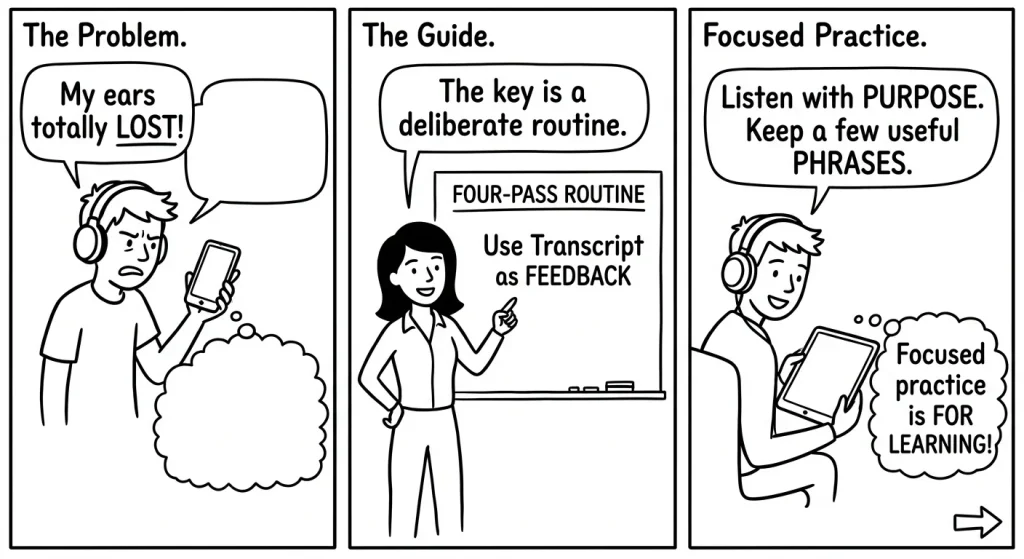
Set aside roughly 15 to 25 minutes for a short segment, depending on its length. You do not need to transcribe the episode. Give each listen a specific job.
Pass 1: Listen for the situation and main point
Play the segment without reading. Do not pause for unknown words. Note the topic, speakers, and one or two points you understood. A rough note such as “two coworkers compare remote-work policies” is enough. You are making a first attempt to build meaning from sound, not testing yourself on every detail.
Pass 2: Find the point where meaning slipped
Listen again. This time, pay attention to a particular question: What reason did the guest give? What changed? Which example supported the speaker’s opinion? Write down only the moments that blocked your answer. If you cannot locate the gap, note the approximate time or replay a short section once.
This second pass should narrow the problem. Perhaps you recognized the words but not where one phrase ended and the next began. Perhaps a reduced form sounded unfamiliar, or a key word was new. You do not need to identify every cause before moving on.
Pass 3: Check the transcript selectively
Open the transcript after you have listened. Find the troublesome span and compare the printed words with what you heard. Check whether you missed a word, mis-segmented a phrase, or misunderstood an expression. Mark a useful chunk or sound-to-spelling link, not every line.
A small quasi-experimental study with 31 advanced ESL learners found a listening-comprehension benefit from a structured sequence that included audio-first listening, transcript-supported listening, and another audio-only listen.[3] The study took place in one instructional program over a semester, so it does not prove that transcripts help every learner in every setting. It does offer a reason to use the text as feedback within listening practice, rather than assuming you must either avoid transcripts or read along from the start.
Pass 4: Listen again without reading
Close the transcript and replay the difficult section, or the whole short segment if it still feels useful. Can you now hear the words and follow the point? Finish with a brief spoken or written retell if you want to connect listening with output. Two or three sentences are enough: what happened, what the speaker argued, or what you think about it.
That retell is a practical extension, not a required step from the study above. Repetition can improve comprehension in some listening tasks, but results from small studies do not establish a universal ideal number of listens. In one study, participants also found repeated listening boring, which is a good reason to keep each replay purposeful.[4]
How to use the transcript without reading instead of listening
Treat the transcript as delayed feedback. If you read it from the beginning, your eyes may carry you through the meaning while your ears remain unsure. Starting with audio gives you a chance to test what you can understand from speech alone. Then the transcript can explain a specific gap, and the final replay lets you check whether the spoken form now registers.
You are not required to hide the transcript at all costs. If you are completely lost, glance at the episode description or a short transcript excerpt to get oriented, then return to the audio. The useful distinction is between reading as support and reading as a substitute for listening practice.
When you check the text, look for phrases that speakers run together, reductions you recognize in writing but not in speech, or an expression whose meaning depends on context. Avoid translating line by line. If a passage still makes no sense after a brief check, that is a cue to switch material, not to create a full dictation exercise.
Turn one episode into reusable vocabulary
Save only a few phrases you can imagine hearing or using again. A collocation such as “raise a concern” or a conversational expression such as “as far as I know” may be more useful than a rare noun tied to a one-off story. Keep the speaker’s wording and a short note about the context. A phrase without context is harder to recognize when it appears elsewhere.
Then write or say a short reaction using one of the phrases, if it fits naturally. You might summarize the speaker’s view or disagree with it. This does not mean every listening session must become a speaking lesson. It gives you a small opportunity to retrieve language rather than merely recognize it on the page.
Vocabulary growth through listening is likely to be gradual. Comprehension, attention to a form, and repeated encounters all matter; there is no fixed replay count that guarantees a word will stick.[2] Revisit a short segment later if it contains language you want to remember. You do not have to replay the whole episode. For a selective way to collect useful phrases, see our guide to sentence mining.
Build a weekly listening diet
A workable week can include one focused episode using the four passes, plus casual listening when it fits your day. The focused session is where you check what you understood. Casual listening gives you more contact with voices, topics, and rhythms without asking every segment to become a lesson.
Keep the routine modest enough to repeat. If a full episode is too long, study a short excerpt. If you have time for more, choose another topic or speaker rather than forcing one recording through endless replays. A small study of podcast listening found that length and repetition affected comprehension in its particular setting, but it cannot tell every learner how long an episode should be.[4]
Once a familiar topic feels easy, vary one feature at a time. Try a new speaker, a different accent, a less familiar subject, or a longer segment. If you change everything at once, it is harder to tell what made listening difficult. Signs you can raise the challenge include following the gist on the first listen more often and needing the transcript less for basic understanding. Keep some material comfortable, too. Extensive listening works best when you can stay with the content, not when every episode becomes a test.
This article focuses on audio and podcasts; the companion article on graded readers and books written for native readers addresses sustained reading, a different selection problem. You can use both formats without expecting one to do the work of the other.
FAQ
Should I listen with the transcript from the start?
Usually, try one audio-only listen first so you can check what you understand. If you are completely lost, use a brief transcript excerpt to orient yourself, then return to the audio. The sequence matters more than a rigid ban on reading.
How many times should I listen to one episode?
Give each listen a different purpose. One pass for gist, another to locate missed meaning, a transcript check, then a final audio replay are a useful starting point. Stop when the replay no longer gives you a clearer understanding. You do not need to complete all four passes every time.
Are native-speaker podcasts too hard for intermediate learners?
Some are, and some episodes are quite approachable. Familiar subjects, clear audio, manageable pace, and a reliable transcript can make authentic material easier to work with. Judge a sample episode rather than the show’s audience label alone.
What if no transcript is available?
You can still listen for gist, replay a short section, and make a brief summary. Use a transcript-supported episode for focused practice when one is available, but do not let transcript availability prevent all casual listening. Avoid guessing at exact wording when you cannot verify it.
Can I learn from podcasts while commuting?
Commuting can be a good time for low-pressure exposure, provided it is safe and you can pay attention to your surroundings. Save transcript checks and focused replay for a time when you can pause and concentrate. Casual listening and study listening can complement each other, but they are not interchangeable.
Start with one short episode
Choose an episode about a subject you already care about, sample it before you commit, and use a transcript only after you have made an honest first attempt to understand the audio. Give each replay a reason. When the segment stops yielding useful information, move on. A podcast routine should make real speech easier to follow over time, not make every listen feel like an exam.
Sources
[1] Ramirez, M. G. (2024). The use of podcasts for language learning: A systematic review of literature. International Journal of English Language Studies, 6(1), 47–53. https://doi.org/10.32996/ijels.2024.6.1.4
[2] Meier, A. (2015). L2 incidental vocabulary acquisition through extensive listening to podcasts. Studies in Applied Linguistics and TESOL, 15(2), 72–84. https://doi.org/10.7916/D8KP9D2G. Columbia Academic Commons record: https://doi.org/10.7916/D8FX8NDN
[3] Hartshorn, K. J., & Stephens, C. (2023). The effects of transcript use on advanced ESL listening comprehension. International Journal of TESOL Studies, 5(4), 55–72. https://doi.org/10.58304/ijts.20230404
[4] Şendağ, S., Gedik, N., & Toker, S. (2018). Impact of repetitive listening, listening-aid and podcast length on EFL podcast listening. Computers & Education, 125, 273–283. https://doi.org/10.1016/j.compedu.2018.06.019
[5] Motamedynia, M., & Nasrollahi Shahri, N. (2022). Investigating the lexical demands of English-as-an-additional-language and general-audience podcasts and their potential for incidental vocabulary learning. Canadian Journal of Applied Linguistics, 25(2), 103–131. https://doi.org/10.37213/cjal.2022.32746
Leave a Reply