
News gives you real English, subjects you already care about, and a reason to return to the language tomorrow. It can also be exhausting. A short article may contain a cryptic headline, unfamiliar names, statistics, reporting verbs, and a long list of words you do not know.
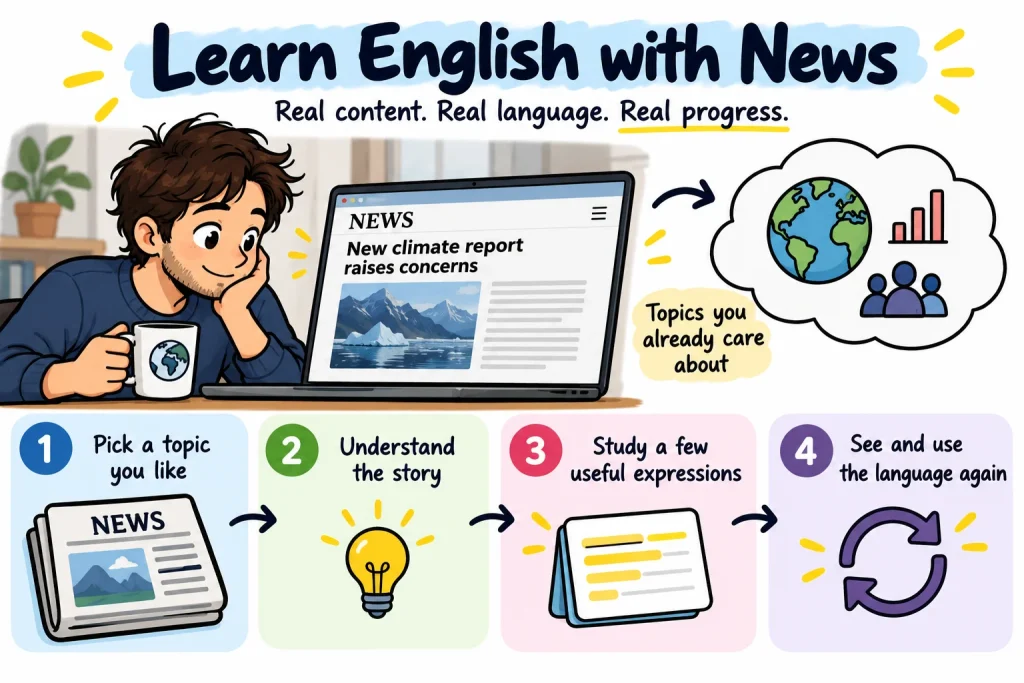
The answer is not to translate every line or wait until you understand everything. To learn English with news, separate two jobs: first, understand what the story says; then, study a few expressions you are likely to see or use again. That distinction turns an information habit into comprehension practice without turning every article into a never-ending lesson.
Why news is useful—and why it is not automatically easy
News exposes you to language patterns that are less common in many coursebooks: ways to attribute information (according to …, the report said), express uncertainty (is expected to …, may lead to …), and explain cause and effect (led to …, raised concerns about …). These patterns are useful because they organize information, not simply because they add an isolated new word.
But an authentic news article is not automatically an easy text. It may compress a great deal of background into a few sentences, introduce references without fully explaining them, or use headlines with ellipsis, wordplay, and cultural references. The British Council’s discussion of the particular challenges in newspaper texts explains why headlines, article structure, and reference chains can demand so much of a reader. That is why making “any news story published today” your fixed assignment is usually less helpful than choosing one you can work with productively.
News also does not replace every kind of practice. It can build comprehension, familiarity with a register, and contextual vocabulary knowledge. To find out whether you can use new language in speaking or writing, you still need opportunities to produce it and encounter it again in other contexts.
Choose a news lane instead of chasing the whole news cycle
Start with a section you would already follow in your first language: technology, business, sports, science, culture, or a region that interests you. Stay with that focus for several weeks. You will see related institutions, ongoing stories, and word families without relying on an arbitrary vocabulary list to repeat itself.
Think of this as narrow news: following a relatively focused beat rather than jumping daily among disasters, elections, markets, and entertainment. It does not guarantee a particular number of learned words. It does, however, make prior knowledge more available. When you already understand part of the story, you can devote more attention to the English that matters.
Before opening an article, check four things:
- A familiar or genuinely interesting topic. A story you have already seen in your first language can be useful scaffolding, not cheating.
- Manageable length. A short report is usually a better starting point than a 2,000-word analysis.
- Author, date, and attribution. These details help you place what you are reading and distinguish current reporting from an old opinion piece or commentary.
- Available support. Audio, a transcript, captions, an informative image, or a learner-oriented version can reduce the load while keeping the language meaningful.
You do not need to decide that a source is “neutral” before using it as learning material. You do need to notice what it states directly, what it attributes to someone else, and what it frames as a forecast or interpretation. When a subject matters, comparing coverage across outlets is both sensible information practice and rich language practice.
Move from supported news to authentic reporting
If an original article overwhelms you, that does not mean news is not for you. It means the current combination of topic, length, and task is too demanding. Authentic materials can be made more manageable by grading the task: one reader can search the same text for one concrete fact while another analyzes it in depth. The British Council’s guidance on authentic materials makes this point clearly: adjust what you ask yourself to do, rather than assuming the only solution is a simpler text.
Begin with news designed for learners
Use learner-oriented resources when you need a bridge between course materials and original journalism. BBC Learning English offers news-based material with language support; its Learning English from the News series is labeled upper-intermediate. It can be especially useful when you want audio, explanations, and a more controlled workload.
This is a bridge, not identical to reading a newspaper or listening to a live report. That is a benefit: you can establish a routine before adding the extra density of authentic reporting.
Continue with short authentic reports
Next, try a brief report on a subject you know. Look for a clear opening paragraph and resist starting with an opinion column. Commentary often requires more cultural background, tolerance for ambiguity, and familiarity with argument than a straightforward report.
Add analysis, interviews, and opinion later
Once you can summarize short reports without stopping every other line, introduce analysis. These formats contain more nuance, argument, and evaluative language. They are valuable, but they are not the best first test of whether you can read news in English.
A two-pass routine to learn English with news
Set aside 15 to 20 minutes as an adjustable starting point. The goal is not to complete a perfect lesson. It is to leave with enough understanding, a few useful expressions, and a reason to read again.
First pass: get the story before studying vocabulary
Read the headline, subheading, and opening paragraph. Then answer these questions, using minimal notes if helpful:
- Who is involved?
- What happened or was announced?
- When and where did it happen?
- Why does it matter, or what cause or effect does the article describe?
Do not open a dictionary at the first obstacle. Mark words that prevent you from answering those questions, then continue. The first reading should answer “What is this about?” rather than “Can I explain every construction?” The British Council’s suggestions for using news articles similarly prioritize an initial reading for the main idea before detailed language work.
If you cannot reconstruct the story after that pass, reduce the difficulty. Re-read only the opening, check a version in your first language, or choose a learner-oriented resource. Spending 30 minutes forcing your way through an opaque text is not automatically high-quality practice.
Second pass: select language that does useful work
Now reread and choose three to five expressions. Favor collocations, connectors, and reporting formulas you can imagine using in another conversation, email, report, or piece of writing. For example:
- according to the report to attribute information;
- is expected to to describe a forecast;
- led to to show a consequence;
- raised concerns about to express concern without claiming certainty.
Infer the meaning from context, then confirm it in a reliable dictionary if needed. Record the meaning it has in that article, not every possible dictionary definition. Save enough of the original wording to remember what the expression was doing.
That deliberate limit matters. A meta-analysis of incidental second-language vocabulary learning finds that learning through exposure is variable; encountering a word is not the same as knowing it well. Paying deliberate attention to a small number of items, then meeting them again later, is a cautious strategy. It does not require pretending that every article will “teach” a complete set of vocabulary.
Add listening when the material provides it
When there is audio and a transcript, listen once without reading if that feels feasible. Then listen with the transcript and locate a main point or an expression you selected. If the first listen gives you almost nothing, start with text and audio together, or return to more supported material. Difficulty is not a character test.
End with a small piece of output
Write three or four sentences about the story, or record a one-minute voice note. Try to keep two layers separate:
The article reports that the company will open a new plant next year. According to local officials, the project may create jobs.
Then add your reaction if you have one: I think the article leaves an important question unanswered. The distinction between reporting and opinion pushes you to use news language more precisely.
Save reusable language, not every unfamiliar item
Save expressions with a reusable function: attribution, probability, contrast, consequence, and evaluation. Combinations that recur in your chosen news lane can be worth saving too, such as interest rate cut, data breach, or clinical trial, if you genuinely return to that subject.
Let go of proper names, numbers that will be outdated tomorrow, isolated acronyms, and technical terms that appear only once—unless they are central to your own interests. Choosing not to save something is not a failure. It protects your attention.
If you like to keep expressions for later review, a tool such as Aprelendo can help keep a phrase connected to its context. The method also works with a notebook or digital note: expression, short excerpt, contextual meaning, and a link to the article are enough. For deciding when a word is worth looking up, see this guide on looking up unknown words while reading in a foreign language.
Read critically: the language of certainty matters
News is an especially good place to notice that English does not present every claim with the same degree of certainty. Compare these formulations:
- The agency said … attributes the claim.
- The agency confirmed … presents a confirmation, though the source of that confirmation still matters.
- The company is expected to … communicates a forecast, not a completed fact.
- The minister allegedly … signals an unproven accusation.
- The report may indicate … limits the strength of a conclusion.
The point is not to memorize a list of “news words.” Ask: Who is saying this? What evidence does the article mention? Is this a fact, quotation, allegation, prediction, or opinion? That question improves comprehension and gives you language you can use more carefully yourself.
Adjust the task to your current level
At B1, choose short, familiar-topic texts. Work with the opening and aim for one main idea plus two details. At B2, add the second language-focused pass and a short written or spoken summary. At C1, compare two reports, track who is being quoted, and analyze how certainty changes between a headline and the article body.
Lower the difficulty if, over several sessions, you still cannot explain the story after a second reading; if you are marking 20 words in every paragraph; or if the topic is so unfamiliar that you would lack a framework for it even in your first language. Raise the difficulty when stories have become predictable and you rarely notice language worth examining.
Avoid rigid comprehension percentages. The useful level is the one that lets you understand something substantial while leaving you enough attention to notice a small amount of language.
A weekly plan that leaves room for real English
For two weeks, try this rhythm: read three short stories from your chosen section; do one session with audio and a transcript; and set aside one day to reread your notes or retell a story to someone. You do not need to “do news” every day. Consistency is more likely when you follow a topic you care about than when you chase a quota.
If you want a lower-friction way to receive texts from a regular source, this guide to adding RSS texts to Aprelendo can be a useful technical companion. But the habit starts before any setup: choose a topic you care about and a task clear enough that you can finish a session having understood something.
The next time you open a news article in English, do not try to conquer every sentence. Identify the story, select three expressions you would genuinely need elsewhere, and write a short summary that separates the article’s claims from your view. Repeated in a topic you truly follow, that small practice is a sustainable way to learn English with news.
Sources
British Broadcasting Corporation. (n.d.). Learning English from the News. BBC Learning English. https://www.bbc.co.uk/learningenglish/news_english
British Council. (n.d.). How to use newspaper articles in language class. https://www.britishcouncil.org/voices-magazine/how-use-newspaper-articles-language-class
British Council. (n.d.). Using authentic materials. TeachingEnglish. https://www.teachingenglish.org.uk/professional-development/teachers/planning-lessons-and-courses/using-authentic-materials
British Council. (n.d.). Using news articles. TeachingEnglish. https://www.teachingenglish.org.uk/professional-development/teachers/managing-resources/articles/using-news-articles
Webb, S., Uchihara, T., & Yanagisawa, A. (2023). How effective is second language incidental vocabulary learning? A meta-analysis. Language Teaching, 56(2), 161–180. https://doi.org/10.1017/S0261444822000507
Leave a Reply