
You read an interview, watch a series, or listen to a podcast and hear an expression you wish you had known yesterday. You understand it well enough from the situation, look it up, and then it disappears a few days later. The obvious response is to save every unfamiliar word. The problem is that this can turn a language activity you enjoy into an endless administrative task.
Sentence mining offers a more selective alternative: choosing a small number of phrases from authentic content, keeping the context that makes a word or expression meaningful, and returning to them over time. Used well, it is not a way to “capture all vocabulary.” It is a way to give useful language a second chance to stick.
This guide is for intermediate and advanced learners who already read, watch, or listen to real-world material. You will learn how to choose what is worth saving, what a useful note can look like, and how to keep review in service of exposure to the language, not the other way around.
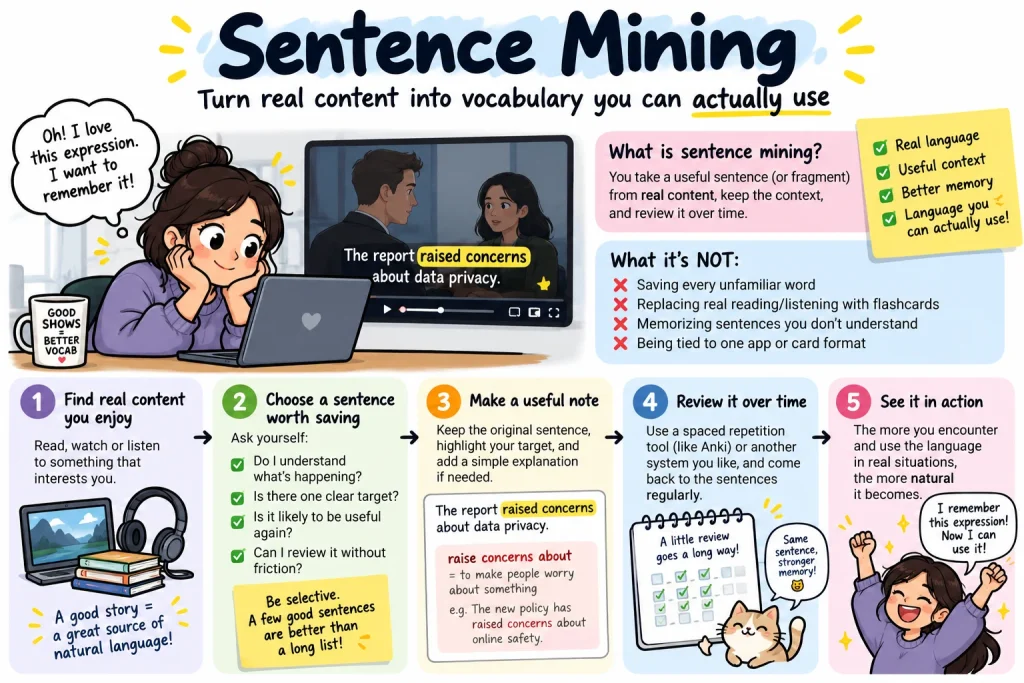
What sentence mining is—and what it is not
In practical terms, sentence mining means taking a sentence, or a sufficiently complete fragment, from something you were already consuming because it contains language you want to learn. The target might be a collocation, a conversational formula, a verb-and-preposition combination, or a grammatical pattern you want to recognize or use.
For example, saving raise as an isolated translation gives you little guidance. Saving this does more:
The report raised concerns about data privacy.
The sentence shows which words tend to occur together and what the expression means in that situation. It also gives you a better chance of recognizing it later in a news report, meeting, or video.
Sentence mining does not mean:
- saving every unfamiliar word;
- replacing reading, listening, conversation, or writing with flashcards;
- memorizing sentences you do not understand; or
- committing to one app or one card format.
Immersion-learning communities popularized the idea of “1T” sentences, i.e. sentences with one main new target. That can be a useful convention for preventing overloaded cards, but it is not a scientific law. It is also not automatically the same thing as Krashen’s i+1, which concerns comprehensible input rather than requiring every flashcard to contain exactly one unknown item.
That distinction matters because the best note depends on what you want to do. You may want to recognize an expression in context, retrieve one specific word, or practice a structure for writing. No single card format is best for every purpose.
When you are ready to start sentence mining
A sensible starting point is when you can follow the main idea of at least some of the content you consume. You do not need to understand every detail, but you should be able to reconstruct the situation after checking an unfamiliar item.
If nearly every sentence contains several unknown words, opaque cultural references, or grammar you cannot yet separate into parts, that is not a failure. It is a sign to choose more accessible material, use subtitles or a transcript, or spend some time building a base before creating cards. A good sentence to learn from does not have to be easy, but it should not become a puzzle every time you review it.
This matches an experiment on vocabulary learning during reading. Encounters with words in a story improved retention compared with words that did not reappear in it, while informative contexts were especially helpful when learners found meaning difficult to retrieve. The practical takeaway is simple: before making a sentence into review material, make sure its context actually helps you understand it.
Use four questions to choose a sentence worth saving
Before saving an item, pause briefly. These questions eliminate much of the material that later makes review feel like a burden.
1. Do I understand what is happening in this sentence?
Look for the meaning it has here, not a long list of dictionary equivalents. If the sentence is still unclear after you check a dictionary, transcript, or the surrounding paragraph, let it go for now.
2. Is there one clear target?
A sentence such as The committee’s decision was widely criticized after the controversial proposal had been unexpectedly withdrawn may contain too many decisions at once. Choose one target: was widely criticized, withdraw a proposal, or a structure you want to notice. Let the rest of the sentence support that target.
3. Is it likely to be useful again?
Prioritize common expressions, patterns connected to your interests, and phrases that are memorable to you. It turns out that…, be expected to…, I’m not used to…, and raise concerns about… are likely to travel farther than the name of an official or a one-off technical term from a single article.
“Useful” can also be personal. A line from a novel you finally understood, a phrase that recurs in your work, or an expression you want in conversation can earn a place even if it is not high-frequency vocabulary.
4. Can I review it without friction?
If it will take several minutes to decode your own note, you probably saved too much. The goal is a clear reminder, not a perfect record. If a card repeatedly fails and provides little value, suspending or archiving it is a useful decision—not a defeat.
How to sentence mine from real content in five steps
The most sustainable way to sentence mine is to build it into content you already want to consume.
1. Consume first
Read the article, watch the video, or listen to the episode with your attention on meaning. Do not pause every few seconds. If every session becomes an extraction operation, you lose both volume of exposure and, often, the enjoyment that made the habit sustainable.
For reading, it can help to separate sessions where you mainly enjoy and move through a text from sessions where you stop to study it. Check out our guide to extensive and intensive reading where we explain that distinction in more detail.
2. Notice items without stopping everything
Mark an expression with a quick highlight, note, or timestamp. At the end of a scene, paragraph, or short section, return to the two or three items that still seem useful. Marking something does not oblige you to save it.
3. Confirm its meaning in context
Read around the sentence again, replay the segment, or check a reliable reference. Ask what the expression is doing: Does it soften a claim? Attribute information? Signal cause, doubt, contrast, or politeness? That function is part of what you are learning.
You do not need to look up every unknown item. This guide to deciding when to look up an unfamiliar word can help you distinguish a doubt that blocks comprehension from one that can wait.
4. Save a compact, contextual note
A minimal note might include:
- the highlighted target;
- the sentence or fragment needed to understand it;
- a short meaning for that context; and
- the source, plus audio, an image, or a link only when it genuinely adds context.
For example:
Front: What does fall through mean here? The deal fell through at the last minute.
Back: It did not happen / it failed. Source: interview about a negotiation.
You do not need to copy an entire paragraph or translate word by word. A fill-in-the-blank card can work well when you want to retrieve one piece: The deal ___ through at the last minute. If recognizing a collocation or its register is more important, the complete sentence may work better. If your target is one word, a word with a supporting example may be enough.
5. Review, then meet or use the language again
Spaced review can help you avoid abandoning an expression after one encounter. In a contextual vocabulary-learning study, spacing encounters supported explicit vocabulary knowledge under the study’s conditions. That does not make a spaced-repetition system a complete solution: recognizing an answer on a card does not prove that you can use it fluently.
After reviewing, take one small action. Write your own sentence that keeps the original meaning, use the expression in a summary, or notice whether it turns up in the next text you read. Those later encounters connect the card to language outside the card.
How many new sentence cards should you add?
There is no universally optimal number. Community guides sometimes recommend high daily quotas; those may work for some people in a particular period, but they are neither an evidence-based prescription nor an obligation.
Start with a deliberately small allowance that you can review even in a busy week. Keep it for two weeks and notice three things:
- How long review actually takes.
- Whether you still want to consume content.
- Whether your cards still make sense when they return.
Increase only if all three are going well. Reduce your allowance if reviews pile up, you avoid content you enjoy, or you answer from visual memory without recovering the meaning. The goal is not to maximize cards. It is to maintain a practice that leaves room for real input.
That caution matters because findings on incidental second-language vocabulary learning vary with learners, materials, activities, and tests. A meta-analysis of incidental vocabulary learning in a second language found learning gains but also substantial differences across studies and conditions. The practical lesson is not to chase a magic number of encounters: combine broad exposure with selective attention to the language you want to keep.
Mistakes that turn a good method into paperwork
Mining everything
A huge list of new words can feel productive on day one and become unmanageable later. Choose deliberately. Leaving a word for another time does not mean giving up on learning it.
Creating cards with several problems at once
An overly difficult sentence makes it hard to know what you missed: vocabulary, grammar, reference, or context. Separate the problem, or wait for a clearer example.
Editing more than you consume
Clipping audio, finding images, and refining layouts can be enjoyable, but they take time. Use those extras when they make the phrase easier to understand, not by default.
Confusing recognition with command
Knowing that carry out means “perform” when you see a card is progress, but it does not guarantee that you will use it in speech. Production needs other opportunities: writing, reformulating, conversation, and further encounters with the pattern in varied contexts.
Varied contexts can be valuable, but you do not have to manufacture them immediately. Research on contextual diversity in Japanese learners of English found delayed recognition benefits from more varied contexts, particularly among learners with greater prior vocabulary knowledge; learners with less vocabulary did not benefit in the same way. The reasonable conclusion is to keep encountering language in diverse material, not to invent ten examples for every word.
Treating the 1T rule as a test
If a sentence has two new items but both are transparent from the context, it may still be manageable. If it has only one new item but the rest is incomprehensible, it may not be. Treat “one main target” as a compass for controlling load, not as an exam.
Try a one-week sentence-mining experiment
For one week, keep the process small:
- Choose content you already enjoy: a short column, a YouTube channel with transcripts, a podcast, or a chapter of a novel.
- Consume normally for 15 to 20 minutes.
- At the end, choose a small maximum number of expressions that pass the four-question test.
- Save compact notes and review them in short sessions.
- At the end of the week, write or record a one-minute summary and try to use one or two expressions only where they fit naturally.
With Aprelendo, you can use this workflow to select a few expressions from a text or video, keep their context close, and revisit them alongside the original material. But the principle works with any notes or flashcard system: choose less, understand more, and return to real language.
The best sentence mining is not measured by the size of your collection. You notice it when a phrase you saved weeks ago appears again and no longer feels unfamiliar. Start with a few expressions from something you genuinely want to read or hear; if review still leaves room to explore more content, the routine is doing its job.
Sources
Nakata, T., & Elgort, I. (2021). Effects of spacing on contextual vocabulary learning: Spacing facilitates the acquisition of explicit, but not tacit, vocabulary knowledge. Second Language Research, 37(2), 233–260. https://doi.org/10.1177/0267658320927764
Oikawa, G., & Uchihara, T. (2026). The effects of contextual diversity on incidental vocabulary learning. Studies in Second Language Acquisition, 1–27. https://doi.org/10.1017/S0272263126101818
van den Broek, G. S. E., Wesseling, E., Huijssen, L., Lettink, M., & van Gog, T. (2022). Vocabulary learning during reading: Benefits of contextual inferences versus retrieval opportunities. Cognitive Science, 46(4), e13135. https://doi.org/10.1111/cogs.13135
Webb, S., Uchihara, T., & Yanagisawa, A. (2023). How effective is second language incidental vocabulary learning? A meta-analysis. Language Teaching, 56(2), 161–180. https://doi.org/10.1017/S0261444822000507
Leave a Reply