
You are halfway through an article in your target language. You understand the topic, then one unfamiliar word appears. You open a dictionary. Two lines later, another word sends you back. By the end of the paragraph, you have collected definitions but lost the point.
If you have wondered, “Should I look up every word when reading?”, the practical answer is no. But “never use a dictionary” is not much better. A dictionary can rescue a sentence, confirm a useful phrase, or stop you building an incorrect guess. The problem is treating every unfamiliar item as equally urgent.
Use lookup to protect meaning and notice language worth keeping. Let the rest wait.
The short answer: do not look up every word, and do not ban lookup
Reading needs continuity to follow the argument, scene, or story, and occasional precision when a word carries the claim, explains an action, or recurs.
Meaning-focused reading can contribute to incidental vocabulary learning, but the results are not a promise that every word encountered will become usable vocabulary. That is one reason a selective approach makes sense. You can preserve the reading experience while stopping for the words most likely to change your understanding or repay later review.
In a flow-focused session, lookups should be exceptional. In a short close-reading session, investigate repeated phrases, grammatical patterns, or precise word choice. In either mode, look up a word that blocks the basic meaning.
The goal is not to prove that you can read without help. It is to make the help serve the text rather than replace it.
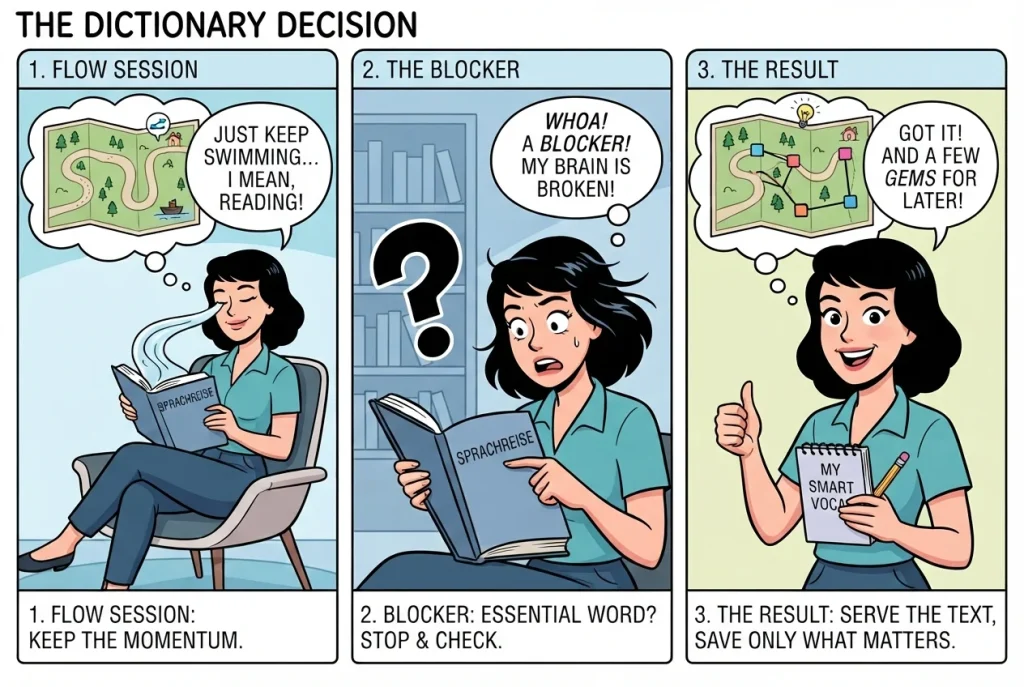
Use the blocker, bridge, and bonus rule
When you meet an unknown word, sort it quickly. You do not need a perfect classification. You need a decision that gets you reading again.
| Type | Signal | Action | Why |
|---|---|---|---|
| Blocker | Without it, you cannot state what the clause, claim, or plot event means. | Look it up now. | It is preventing comprehension, not merely adding texture. |
| Bridge | It recurs, appears in the title, links parts of the argument, or names a central thing. | Look it up, then decide whether to save it. | Understanding it improves more than one sentence. |
| Bonus | You can follow the text, but the item is personally relevant, memorable, or useful for your goals. | Look it up if you have room in your small harvest. | Interest can make an item worth collecting, even if it is not essential. |
| Everything else | It is descriptive, rare, or recoverable from the surrounding meaning. | Make a light mark or let it pass. | Stopping would cost more than the definition gives you today. |
This rule works because it asks about the word’s job in this particular text. Novelty alone is a weak reason to interrupt yourself. Centrality and recurrence are better signals.
A blocker prevents a basic paraphrase
Suppose you read: “The council postponed the vote after the coalition fractured.” If you do not know fractured and cannot infer it, the political event is unclear. Did the coalition grow? Win? Break apart? That is a blocker.
Look it up, take the relevant sense (“split into parts; broke apart”), and return to the sentence. Do not keep browsing every possible dictionary definition. You only need the sense that makes this sentence work.
A bridge carries the text across several sentences
In an article about housing, tenancy, tenant, and tenants’ rights may recur. A blurry idea of “something to do with renting” lets you continue, but checking the term and noticing phrases such as secure tenancy and tenant protections gives you a map of the article.
A bonus is optional, not trivial
Perhaps a travel writer describes a market as bustling. You already understand that it is crowded and lively. If you are reading for pleasure, move on. If you plan to describe places in English, the word may be a good bonus item.
The distinction matters. A bonus is worth learning because it fits your life or interests, not because a dictionary exists.
Decide in under ten seconds
Long internal debates are another form of interruption. Ask four quick questions instead.
Can I still say the sentence’s basic meaning?
Do not demand a polished translation. Give yourself a rough paraphrase in the target language or your strongest language.
For example: “The company curtailed spending after profits fell.” If you can say “They spent less because profits went down,” you already have enough to continue. Curtailed may be a bridge or bonus, but it is not necessarily a blocker.
Does it recur or carry the argument?
Check a word that appears in the headline, in a subheading, at the start and end of a paragraph, or in a repeated contrast. Writers often repeat the vocabulary that organizes their point.
A one-off adjective in a long scene can wait. A repeated verb in an explanation usually cannot.
Can context give you enough for now?
Context is not a test of whether you can guess the exact dictionary definition. It asks whether you have a usable working meaning.
Use nearby words, grammar, cognates, pictures, and what you already know about the topic. If a recipe says “whisk the eggs until frothy” and shows a bowl covered in bubbles, “full of bubbles” is enough. You can confirm the exact word later if it recurs.
Be more cautious with words that reverse a claim: negations, quantities, modal verbs, comparison words, and verbs of cause. Misreading barely, unless, despite, or prevent can distort the whole sentence even when you know all the nouns.
What kind of reading session is this?
If you chose a short extract for study, you can be curious about more details. If you sat down to read a chapter for story and momentum, protect that purpose.
The same page can support both modes. Read it once for meaning; later, return to a useful or confusing paragraph. Extensive vs. Intensive Reading explains how to give each mode a distinct job.
See the rule in a short paragraph
Here is an original example. Imagine that you are reading a short local-news report:
After several delays, the city opened a temporary bridge across the river. The structure will remain in place while engineers reinforce the damaged embankment. Residents welcomed the detour, although some said the new route was cumbersome during the morning rush. The mayor called the project a stopgap rather than a permanent solution.
Assume that the bold words are unfamiliar.
- Temporary is probably not a blocker. Will remain in place while tells you that the bridge is not permanent.
- Reinforce is a bridge. It explains the reason for the bridge and is likely to matter again in a report about repairs. Look it up: “make stronger.”
- Detour may be a blocker if you cannot tell what residents must do differently. The context suggests “a different route,” but a quick lookup confirms it.
- Cumbersome is likely a bonus. You know the route is inconvenient. If you like the word, save it with the phrase cumbersome during the morning rush.
- Stopgap is a bridge. It sharpens the final contrast: this project is a temporary measure, not the long-term answer.
Two or three lookups gave you the structure of the paragraph. The rest could wait.
After lookup, save the part you will actually use
A lookup only becomes reviewable material when you keep the information that made it meaningful.
Save the relevant sense, not the entire entry
Many dictionary entries list several senses. Copying all of them creates noise.
For charge, the useful sense might be “ask a price” in a restaurant review, “accuse formally” in a news report, or “move forward quickly” in a sports report. Record the sense your text used.
Keep a sentence fragment and a phrase
A bare translation is hard to retrieve later. Save reinforce the damaged embankment = make the riverbank stronger after damage, not merely reinforce = strengthen. The phrase preserves the situation and the words that naturally go together.
Keep the harvest small enough to revisit
A page can contain twenty attractive words. Choose only the small set you can revisit. A dense editorial and a relaxed chapter do not make the same demands.
Aprelendo can fit here as a practical tool: use in-context lookup, save the original sentence or phrase, then review the selected items later. The method does not depend on the tool; a notebook or flashcard app can do the same job if it preserves context.
A page full of blockers is feedback, not a discipline problem
If every sentence contains several words you need before you can follow the basic meaning, selective lookup will still feel exhausting. The problem may be the material-task match.
Vocabulary coverage research is useful as background because it shows how strongly comprehension depends on knowing a large share of the running words in a text. But published coverage figures are planning benchmarks for particular text types and languages, not a personal pass/fail threshold you can calculate while reading.
Try one of these adjustments instead:
- Read a shorter item on the same topic, then return to the harder text.
- Choose a genre with more support: a video with visuals, an article with headings, or a familiar series with recurring characters.
- Read the first pass for gist, accepting gaps, before doing a focused paragraph.
- Use a scaffold, such as a target-language summary, a glossary, or a trusted translation for one difficult section.
Changing the text or task is often more productive than forcing yourself through a dictionary-heavy page.
Avoid four common traps
Translating every sentence
Translation can solve a difficult line, but doing it automatically turns reading into a different task. Solve only what blocks the sentence’s role in the text.
Trusting the first dictionary sense
The first sense may be common rather than correct. Check the example sentence, part of speech, and nearby words.
Saving every highlight
Highlights record attention, not priorities. Select after you understand the paragraph.
Never meeting a selected item again
At review, recall the situation or complete the phrase before checking the definition.
FAQ
Is guessing from context better than dictionary lookup?
Guess when context lets you keep reading. Look up when a wrong or vague guess would damage the sentence, or when the item is central.
Should I look up grammar too?
Look up grammar when it changes who did what, when it happened, or how certain the writer is. Otherwise, mark it and continue.
What if I understand almost nothing without a dictionary?
Try a shorter or more familiar text, add a scaffold, or read for a narrower goal. If blockers remain dense, park the text.
Does this apply to subtitles and transcripts?
Yes, with one change: audio moves quickly. During viewing, preserve the main thread. Afterward, use a short transcript segment to inspect the phrases you missed. Choose the subtitle setting for your goal rather than looking up each missed word in real time; the caption guide explains the trade-offs.
Read the next page with a purpose
On your next reading session, do one small experiment. Before you begin, decide whether the session is for flow or close study. Then use blocker, bridge, and bonus for one page. Save only the items you could explain to yourself as useful.
If the page still feels like a chain of emergencies, do not add more willpower. Change the text, the task, or the support around it. Reading gets more useful when you can keep the thread and occasionally stop for language that genuinely matters.
Sources
- Webb, S., Uchihara, T., & Yanagisawa, A. (2023). How effective is second language incidental vocabulary learning? A meta-analysis. Language Teaching, 56(2), 161–180. https://doi.org/10.1017/s0261444822000507
- Nation, I. S. P. (2006). How Large a Vocabulary Is Needed for Reading and Listening? The Canadian Modern Language Review / La revue canadienne des langues vivantes, 63(1), 59–81. https://doi.org/10.1353/cml.2006.0049
Leave a Reply