You open a novel in your target language, get through half a page, and start wondering whether you picked the wrong book or simply need more practice. That question is more useful than asking whether you are “advanced enough.” A book can be difficult because of its vocabulary, but also because of long sentences, unfamiliar genre conventions, cultural references, or a writing style you have never met before.
You do not have to choose graded readers or native books once and for all. The practical question is whether a particular book works for the kind of reading you want to do right now. A short sample can help you decide whether to read it for flow, study a passage more closely, or set it aside and try another route.
The wrong question is not “Am I advanced enough?”
A CEFR level can give you a rough sense of your general ability, but it cannot tell you whether a specific mystery, memoir, graphic novel, or essay collection will suit you. Two books aimed at native readers can feel worlds apart. A familiar contemporary novel may be easier to follow than a children’s fantasy full of invented names, wordplay, and unusual expressions.
Difficulty has several sources. You may know most of the words but struggle to parse a sentence that runs across several lines. You might understand each sentence yet miss why a character acts as they do because the story assumes cultural knowledge you do not have. A book’s genre matters, too: the language of a courtroom drama, a historical novel, and a personal blog differs in predictable ways, but each brings its own conventions.
Familiarity can help. If you already know the subject, characters, or story, you can use that knowledge to make sense of a passage when the wording is new. Open University’s advice on choosing target-language texts recommends starting with material you enjoy in your first language and notes that familiarity with a topic can make reading easier. That is useful guidance, not a promise that a known story will be linguistically simple. Translations can still contain challenging prose, and an old favorite may use an unfamiliar register.
Choose a book you would genuinely want to read, then judge the pages rather than the label on the cover. Prestige is a poor proxy for fit. The goal is to find a text that gives you enough meaning to keep going, with a manageable amount of effort for the purpose you have in mind.
Graded readers and native books solve different problems
What graded readers make possible
Graded readers are written or adapted for learners, often with controlled vocabulary and grammar. Their limits can be useful: when fewer passages stop you, it is easier to read continuously and cover more pages. If you are rebuilding a reading habit or want material for regular, lower-friction reading, a well-chosen graded reader can be a better fit than a book that turns every paragraph into a decoding exercise.
Extensive reading programs have shown positive effects on reading proficiency in aggregate. A 2016 meta-analysis of extensive reading included 49 primary studies and found small-to-medium effects across the samples it analyzed. The findings support extensive reading as a broad approach; they do not show that any one native-market novel will improve your reading, or that there is a single point when a learner should stop using graded material.
What books for native readers add
Books written for native readers expose you to language shaped by real audiences and purposes. They can introduce naturally occurring register, genre conventions, references, and phrasing that learner materials may limit or adapt. That makes them worthwhile, but not automatically the best choice for every reading session.
A difficult book may be useful as a short study passage even when it is too demanding for relaxed, sustained reading. The distinction is about how you use the text, not whether the text is “real” enough. For a fuller explanation of the two reading modes, see our guide to extensive and intensive reading.
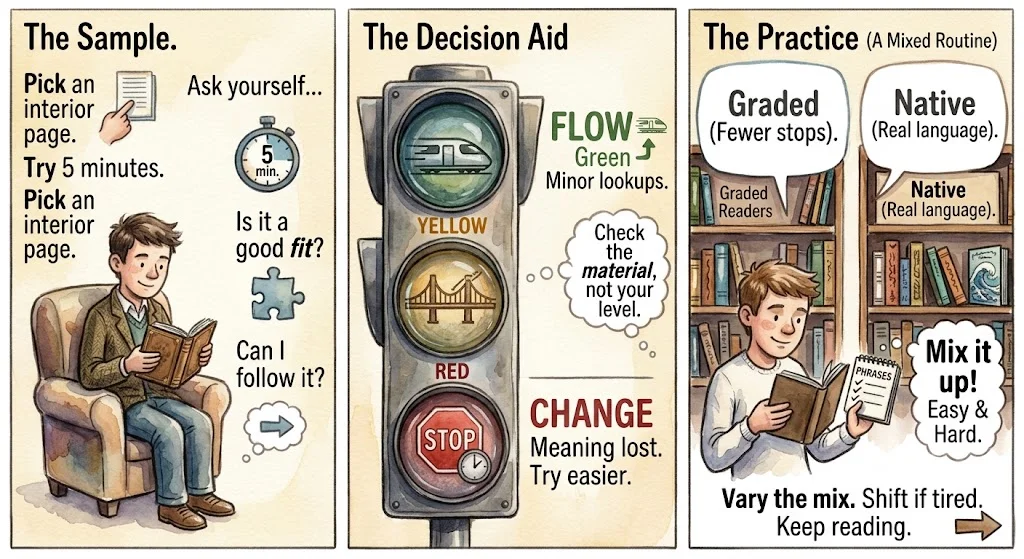
There is no need to treat graded readers as a rung you must leave behind. You might read an easier story for continuity during the week and explore a chapter of a native-market book on the weekend. A mixed reading routine lets you keep time for reading while still testing more demanding material. It is a practical arrangement, not a research-established ideal ratio.
Test the book, not its cover
A short sample will not diagnose your language level, but it can tell you something useful about this book and your current reading goal. The five-minute suggestion below is an editorial heuristic, not a validated test. Use a representative interior page, and remember that one page may be unusually easy or difficult.
Try a five-minute sample
Choose a page from the middle of the book. Avoid relying only on the opening, which may introduce a cast of characters, or a page that happens to contain a poem, glossary, or technical explanation. Read for a few minutes without stopping for every unknown word. Then close the book and ask yourself:
- Can I explain what happened or what the writer is arguing?
- Can I work out at least some unfamiliar words from the sentence or situation?
- Can I keep reading without repeatedly losing the thread?
- Did I want to know what came next, or was I mostly managing the language?
Notice how often you have to stop, but do not treat every interruption as equal. A proper name you can safely ignore is different from an unknown verb that changes what a character did. A transparent cognate may be easy to infer, while a familiar-looking word may mean something different in context. Counting unknown items can help you compare two books, but it cannot capture those differences or serve as a universal pass/fail score.
Researchers have studied vocabulary coverage and comprehension in specific settings. For example, Nation’s discussion of vocabulary size for reading reviews English-language estimates and evidence tied to particular texts and comprehension criteria. Such figures are not a universal permission threshold: your language, genre, background knowledge, reading purpose, and willingness to consult support all affect the experience. Instead of asking whether you meet a fixed percentage, pay attention to whether the gaps disrupt your understanding and momentum.
Use a traffic light as a decision aid
The colors are a simple way to organize your observations, not a validated scale.
Green: read for flow. You can follow the main thread, infer some gaps, and keep going without constant effort. Keep a light hand with lookups and let the story carry you. If the book is enjoyable, read on.
Yellow: use a short passage for study. You care about the material, but frequent pauses or dense sentences make sustained reading tiring. Choose a few pages or a short section to examine more closely. You can return to it later, or read an easier book alongside it.
Red: change the conditions or save it for later. If you cannot tell what is happening after a few paragraphs, and most of your attention goes to translating rather than following the text, this may not be the right book for relaxed reading today. Try a different format, an easier level, a more familiar subject, or a passage with helpful illustrations. You can also defer the book without deciding it is beyond your ability.
The same book can move between colors depending on your purpose. A challenging page may be red for a quick evening read and yellow for a focused study session. The point is to choose deliberately, not to grade yourself.
Build a bridge instead of making a leap
You can make the transition gradual. Start with material that keeps one or two things familiar while the language becomes less controlled. Short stories, comics, magazine articles, and accessible nonfiction let you try native-market writing without committing to a long novel. A translation of a book you know can reduce the work of following the plot, though it will not remove unfamiliar phrasing or cultural details.
Children’s books are another possible format, but “for children” does not mean “easy for an adult learner.” OpenLearn warns that children’s texts can use playful language, invented words, and expressions drawn from children’s experiences. A picture book may offer useful visual clues; a fantasy novel for young readers may be harder than its audience label suggests. Try a page before choosing.
If a full novel feels like too large a step, choose a short native text in a genre you already enjoy. If you want a longer story, look for a familiar setting or plot. You can also pair one easy volume book with one “stretch” text, rather than making every reading session a test. Adjust the mix based on how often you read and how much effort you want to spend that day.
Stepping down is part of choosing material, not evidence that you have failed. If an ambitious book is draining your reading time, put it aside and return when the subject or language feels more accessible. The important information is what the sample tells you about this book, under these conditions.
Read a real book without turning it into a word list
When you try an authentic book, you do not have to look up every unfamiliar item. Consider checking a word if it blocks the plot, appears repeatedly, or matters to you for another reason. Let less important gaps wait. Our article on looking up unknown words explores that choice in more detail.
After a session, save a small number of useful words or sentences rather than copying every unfamiliar expression. A word that recurs or helps you understand a scene is more likely to be worth revisiting than a one-off detail you can ignore. See our guide to sentence mining for a method of collecting examples from real content.
Try a two-week experiment. Keep the book nearby and read a little at a pace you can sustain. Alongside it, keep an easier text available so a difficult chapter does not end your reading for the day. At the end of two weeks, ask whether you enjoyed the material, whether you could resume without rereading whole sections, and whether you usually understood the story or argument. These are personal review prompts, not validated measures. If the answers are mostly no, change the book or the way you are using it.
If repeated frustration with reading seems part of a broader plateau, our practical plateau diagnostic may help you consider other causes. A mismatched book is only one possibility.
FAQ
Is B1 enough to start a native novel?
It can be, depending on the novel and your goal. A B1 learner may follow a familiar contemporary story with selective lookup, while a supposedly simpler book can be hard because of style, genre, or references. Sample the actual text instead of treating a CEFR level as a yes-or-no rule.
Are children’s books always easier for language learners?
No. Some use short sentences and illustrations, but others rely on playful expressions, invented words, or knowledge of children’s lives. The intended age is not a reliable difficulty label for an adult learner. Read a sample page first.
Should I read a translation of a book I already know?
It can be a useful bridge because you already know the plot and characters. That familiarity may help you keep track of the story when the language is unfamiliar. Still, the translation may use challenging vocabulary, syntax, or a different style from the original, so test a page before committing.
How many unknown words are too many?
There is no universal number. A few important gaps can make a story hard to follow, while many minor words may not stop you from understanding the main thread. Notice whether unknown words block meaning, cause repeated interruptions, or make the reading experience unpleasant for your current purpose.
Can I alternate graded readers and native books?
Yes. You can use graded readers or other accessible texts when you want sustained reading, and sample native books when you want more demanding language or a particular subject. There is no need to finish one category before starting the other.
Choose the next page, not a permanent level
Pick one book you are curious about and read an interior page for a few minutes. If you can follow the thread and want to continue, give it a place in your reading routine. If it takes too much effort, use a short passage for study or choose a more accessible text for now. The useful outcome is not a verdict on your ability; it is a better match between the book and the way you want to read.
Sources
Jeon, E.-Y., & Day, R. R. (2016). The effectiveness of extensive reading on reading proficiency: A meta-analysis. Reading in a Foreign Language, 28(2), 246–265. Full text
Nation, I. S. P. (2006). How large a vocabulary is needed for reading and listening? Canadian Modern Language Review, 63(1), 59–82. DOI
Open University. (n.d.). How to learn a language: I want to read texts in my target language: Where should I start? OpenLearn. OpenLearn unit
Leave a Reply