
You know that feeling when you open a book in your target language and suddenly every sentence feels like a boss fight?
That’s exactly why graded readers exist.
They’re not “baby books.” They’re strategically simplified stories designed to help your brain absorb vocabulary naturally instead of memorizing random word lists like a robot from 2007.
And when you combine graded readers with the right learning system—like Aprelendo—you turn casual reading into a vocabulary growth machine.
Here’s how to make it work without burning out or drowning in flashcards.
Why Graded Readers Work Better Than Vocabulary Lists
Your brain loves patterns and context.
When you study isolated words like:
- chair = silla
- window = ventana
- dog = perro
…your brain treats them like temporary trivia.
But when you read:
“The dog jumped through the window because it smelled food.”
your brain suddenly has:
- emotion
- action
- imagery
- context
- repetition
That’s what creates durable memory.
Vocabulary sticks when your brain understands why the word matters.
This is also why people who binge Netflix in another language often improve faster than people doing endless grammar worksheets. Context creates connections.
The Biggest Mistake People Make with Graded Readers
They choose books that are too hard.
If you need a dictionary every 12 seconds, your brain switches from “learning mode” to “survival mode.”
The sweet spot is understanding about 90–95% of the text.
That means:
- You follow the story easily
- Unknown words feel guessable
- Reading stays enjoyable
- Your brain keeps acquiring vocabulary passively
Struggle doesn’t always equal progress. Sometimes it just means your material is badly matched to your level.
Aprelendo is useful here because it helps automate exposure and reinforcement instead of forcing you to manually track every new word like an exhausted librarian.
How to Read for Maximum Vocabulary Gain
1. Read Fast First
Don’t stop for every unknown word.
Seriously.
Your goal on the first pass is understanding the story, not achieving dictionary perfection.
If a word appears multiple times, your brain starts predicting its meaning naturally. That prediction process is incredibly powerful for memory formation.
Think of it like meeting someone at a party:
The first time? You forget their name instantly.
The fifth time? Your brain goes:
“Ohhh right. That guy.”
Vocabulary works the same way.
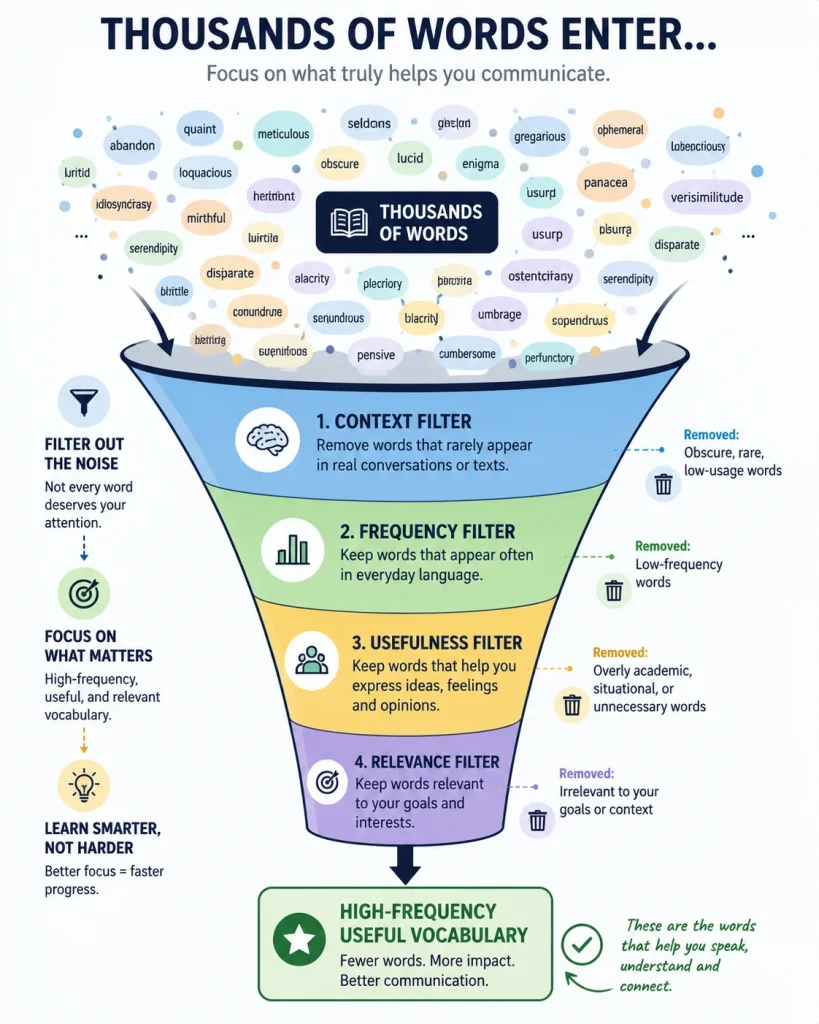
2. Save Only High-Value Words
Not every word deserves your attention.
If you encounter:
- highly frequent words
- emotional expressions
- conversational phrases
- connectors and transitions
…those are gold.
But obscure vocabulary like “medieval shovel technician”? Probably not urgent.
The fastest learners aren’t learning more words. They’re learning the right words repeatedly.
This is where Aprelendo becomes the natural next step. Instead of manually organizing vocabulary, the app helps reinforce useful language through repeated exposure and intelligent review cycles.
The “3 Encounter Rule”
Here’s a simple trick most learners ignore:
Don’t study a word the first time you see it.
Wait until it appears 3 times.
Why?
Because repetition filters importance naturally.
If a word keeps showing up in stories, conversations, or dialogue, your brain labels it as relevant.
That means less wasted effort and faster retention.
Example:
- First encounter → confusion
- Second encounter → familiarity
- Third encounter → acquisition begins
Vocabulary learning is less about force and more about strategic exposure.
Combine Reading with Tiny Speaking Sessions
This is where the magic happens.
After reading one chapter, summarize it out loud in simple language.
Even badly.
Especially badly.
Your brain strengthens vocabulary dramatically when it shifts from:
- recognition → production
That transition is huge.
You don’t need perfect grammar. You need retrieval practice.
A simple summary like:
“The man was scared because he lost his bag.”
does more for fluency than silently rereading the chapter five times.
This “connection-first” approach matters because language is ultimately about communication—not collecting grammar trophies.
The Best Reading Habit Is Surprisingly Small
Most people fail because they try to read for an hour daily.
Terrible strategy.
Consistency beats intensity.
Read:
- 10 minutes daily
- one short chapter
- one scene before bed
That’s enough.
Your brain learns languages through repeated contact, not heroic study marathons fueled by panic and coffee.
In fact, shorter sessions often improve retention because your brain stays attentive instead of mentally wandering into snack-related fantasies.
Small daily exposure creates compound growth.
Turn Stories Into Vocabulary Momentum
Graded readers work because they make language feel alive.
You stop translating every sentence.
You stop obsessing over perfection.
You start experiencing the language instead of analyzing it.
That’s when vocabulary growth accelerates.
And when paired with a system like Aprelendo, you remove much of the friction that normally kills consistency.
The result?
More reading.
More exposure.
More useful vocabulary.
Less suffering.
Which, honestly, is one of the best language-learning strategies ever invented.
Leave a Reply