
You’ve seen it before.
You study a word ten times in a flashcard app. You swipe right. You get it “correct.” You feel productive.
Then two days later, the word vanishes from your brain like it never existed.
Meanwhile, you somehow remember random phrases from a TV show you watched once at 1 a.m.
So what’s going on?
The problem isn’t your memory. It’s the way most language apps treat memory in the first place.
Most flashcard systems assume that repetition alone creates learning. But your brain doesn’t work like a photocopier. It works more like a prediction machine. Words stick when they feel useful, emotional, surprising, or connected to something real.
That’s why some vocabulary becomes permanent after one encounter while other words disappear after 50 reviews.
Here’s the part most apps miss.
Your Brain Doesn’t Store Words. It Stores Experiences.
Think about the word “apple.”
You don’t remember it because you reviewed a card 37 times.
You remember it because your brain attached it to images, taste, conversations, school lunches, maybe even your favorite pie.
In other words: memory is contextual.
But most flashcard apps isolate words from the situations that give them meaning.
You get this:
- “To borrow = prendre temporairement”
- “Chair = silla”
- “Opportunity = Gelegenheit”
Technically correct. Practically forgettable.
Your brain struggles because isolated information has nothing to attach itself to. It’s like trying to hang a picture frame in midair.
The brain loves patterns, stories, emotions, and social meaning. That’s why you’ll remember:
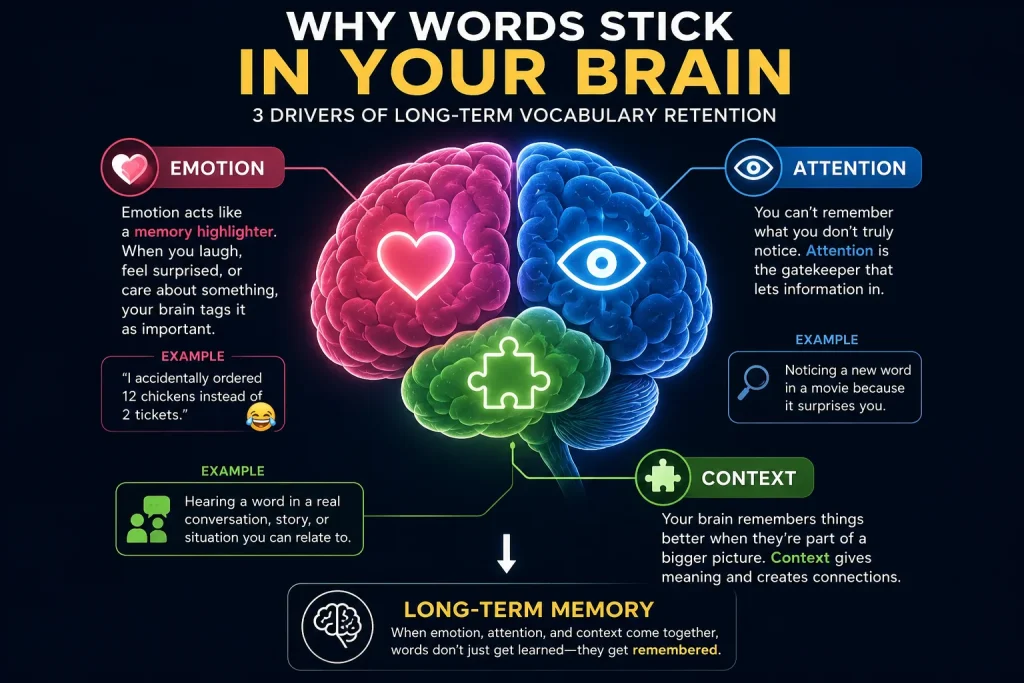
“I accidentally asked for 12 chickens instead of 2 tickets.”
…far longer than a clean dictionary definition.
Because now the word has tension. Emotion. Context. A mini-story.
And your brain pays attention to stories.
Attention is the real gateway to memory. Not repetition.
Why “Easy” Learning Often Fails
Here’s something counterintuitive:
The easier a word feels during study, the less likely you are to remember it later.
That’s because recognition is not the same as recall.
When you see a flashcard and think, “Oh yeah, I know this,” your brain may simply recognize the pattern. But recognition is passive. Real language use requires retrieval.
And retrieval is effortful.
This is why students often freeze during real conversations despite crushing their flashcard streaks.
Their brain learned how to identify the word.
Not how to use it.
Good memory formation needs a little friction. Not overwhelming difficulty. Just enough struggle to force your brain to rebuild the connection.
It’s similar to exercise.
Watching workout videos doesn’t build muscle. The strain does.
Language works the same way.
That’s why the most effective learning moments usually look messy:
- Searching for the right word
- Making mistakes mid-sentence
- Hearing a phrase repeatedly in different contexts
- Laughing at something unexpected
- Needing the word to express a real thought
These moments feel slower than tapping through cards.
But they create deeper memory traces.
Your brain remembers what it had to work for.
The Emotional Shortcut Most Apps Ignore
There’s another reason random phrases stick.
Emotion acts like a memory highlighter.
If something makes you laugh, cringe, panic, or feel understood, your brain tags it as important.
That’s survival logic.
A boring vocabulary list triggers almost none of this.
But a meaningful interaction does.
This is why people remember:
- Song lyrics effortlessly
- Quotes from movies
- Inside jokes in another language
- Embarrassing mistakes from trips abroad
Emotion creates priority.
And surprisingly, humor works especially well because it combines attention, surprise, and emotion all at once.
That’s why weird examples outperform sterile textbook sentences every time.
Compare these:
- “The cat sits on the table.”
- “The cat stole my sandwich and made eye contact while doing it.”
Your brain already chose a winner.
The Real Goal Isn’t Memorization. It’s Connection.
This is where language learning gets misunderstood.
People often treat vocabulary like collecting Pokémon cards. More words = more fluency.
But language isn’t storage. It’s connection.
You don’t learn words to “know” them.
You learn them to:
- tell stories
- understand people
- react faster
- joke naturally
- express identity
- belong somewhere
And your brain knows the difference.
When learning feels socially meaningful, retention increases automatically because the information gains personal value.
That’s also why immersion works so well. Not because it’s magical, but because the words stop being abstract.
They become tools.
A menu item matters when you’re hungry.
A phrase matters when you’re flirting.
Directions matter when you’re lost.
Meaning creates memory.
This is the philosophy behind newer learning systems like Aprelendo. Instead of treating vocabulary like isolated data points, the focus shifts toward interaction, context, and naturally repeated exposure — the way real language sticks outside the classroom.
Because ultimately, fluency isn’t about remembering more flashcards.
It’s about reducing the distance between a thought and the ability to express it.
So What Actually Makes Words Stick?
Not endless repetition.
Not streaks.
Not grinding vocabulary lists until your soul leaves your body.
Words stick when your brain decides they matter.
And your brain usually makes that decision based on:
- context
- emotion
- usefulness
- repetition across real situations
- effortful recall
- social meaning
The good news?
This means forgetting isn’t failure. It’s feedback.
If a word disappears instantly, the issue usually isn’t intelligence. The connection simply wasn’t strong enough yet.
So next time a flashcard refuses to stick, don’t just review it again.
Use it in a sentence.
Make it ridiculous.
Attach it to a memory.
Say it to someone.
Turn it into something your brain can actually care about.
Because the words you truly own are rarely the ones you memorized hardest.
They’re the ones that became part of your life.
Leave a Reply