
Flashcards are one of the most widely used tools in language learning. Apps like Anki, Quizlet, and others have popularized spaced repetition, a system that schedules reviews at increasing intervals to help memory last longer.
Spaced repetition is powerful. But it is only the beginning.
Research in cognitive science and applied linguistics suggests that the way you use flashcards can matter just as much as when you review them. In fact, several evidence-based techniques can dramatically increase how effective flashcards are for building durable, usable vocabulary.
Let’s look at some of the most important ones.
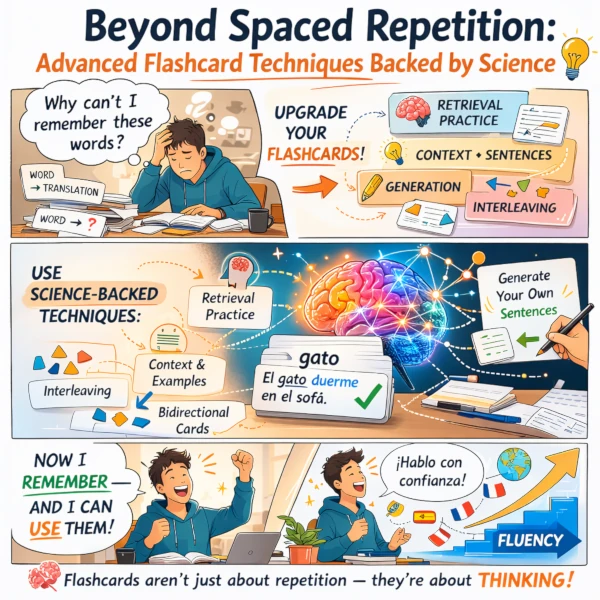
1. Retrieval Practice: The Engine of Learning
The most important principle behind flashcards is retrieval practice.
When you look at a flashcard and try to recall the answer before flipping it, your brain is performing a memory retrieval. This act strengthens the neural pathway associated with that memory.
Studies by cognitive psychologists such as Henry Roediger and Jeffrey Karpicke show that testing yourself is far more effective than re-reading information. In other words, actively recalling a word strengthens memory much more than simply reviewing a list.
This means a flashcard session should never feel passive. If you immediately reveal the answer without trying to remember it first, you lose most of the learning benefit.
The struggle to remember is not a problem. It is the learning process itself.
2. Elaborative Encoding: Add Meaning, Not Just Translation
A common mistake with flashcards is treating them as simple translation pairs:
gato → cat
While this works initially, it creates shallow memory traces.
Cognitive research shows that memory improves when new information is linked to meaning, imagery, or associations. This is known as elaborative encoding.
Instead of simple pairs, richer flashcards might include:
- a short example sentence
- an image
- a synonym or explanation
- a personal association
For example:
Front: gato
Back: “cat” — El gato duerme en el sofá.
By connecting the word to context, you give the brain more pathways to retrieve it later.
3. Interleaving: Mix Different Types of Cards
Another technique supported by learning science is interleaving.
Instead of reviewing similar cards in blocks (for example, ten food words in a row), interleaving mixes different categories together.
Why does this help?
Because the brain must actively discriminate between concepts. Each retrieval requires a small decision rather than a simple pattern repetition.
Research shows that interleaving improves long-term retention and the ability to apply knowledge flexibly.
For language learners, this means mixing verbs, nouns, phrases, and even grammar patterns in the same deck.
4. Generation: Produce the Language Yourself
One of the most powerful techniques is called the generation effect.
People remember information better when they generate the answer themselves rather than simply recognizing it.
Traditional flashcards often rely on recognition:
Front: chien
Back: dog
But production is much stronger:
Front: “dog” → French
Back: chien
Better still is generating language in context:
Front:
“The dog is sleeping.” → French
This kind of card forces the brain to actively construct language rather than passively identify it.
5. Bidirectional Cards: Train Both Directions
Many learners only study flashcards in one direction:
foreign word → native translation
But real language use requires both recognition and production.
To strengthen both pathways, it helps to create bidirectional cards:
- word → translation
- translation → word
This simple change significantly increases the number of retrieval pathways available during real conversation.
6. Context Cards: Move Beyond Single Words
Vocabulary rarely exists in isolation.
Research in applied linguistics consistently shows that words learned in context are easier to remember and easier to use.
Instead of studying isolated words, many effective learners create flashcards based on phrases or sentences from real texts.
For example:
Front:
“to take something for granted”
Back:
meaning + example sentence
These kinds of cards capture not just vocabulary, but collocations and natural phrasing, which are essential for fluency.
7. Desirable Difficulties: Make Cards Slightly Challenging
Psychologist Robert Bjork introduced the concept of desirable difficulties.
Learning improves when tasks require a moderate amount of effort. If something feels too easy, the brain processes it superficially.
Flashcards should therefore be slightly challenging, not trivial.
This might include:
- partial sentences with a missing word
- prompts that require forming a phrase
- cards that combine grammar and vocabulary
A small amount of difficulty slows learning in the short term, but dramatically improves long-term retention.
Bringing It All Together
Spaced repetition determines when you review information.
But techniques like retrieval practice, elaborative encoding, interleaving, generation, and contextual learning determine how deeply that information is stored.
When these methods are combined, flashcards transform from simple memorization tools into powerful engines of language acquisition.
For learners building large vocabularies—or converting passive knowledge into active fluency—the difference can be enormous.
In the end, effective flashcards are not just about repetition.
They are about thinking.
Leave a Reply