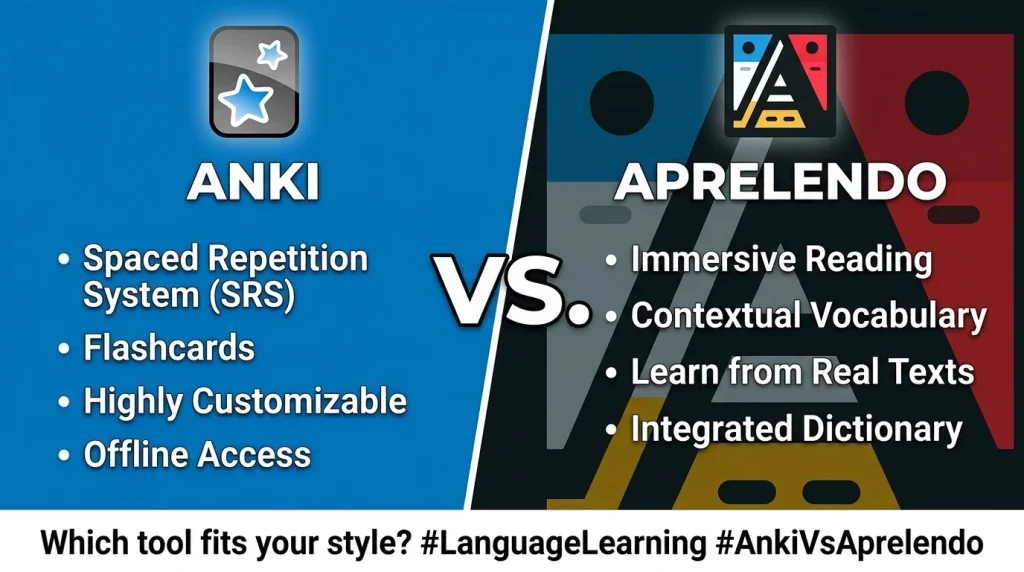
If you’ve spent any time researching language-learning tools, you’ve probably come across Anki.
It’s one of the most recommended apps in language-learning communities, especially among serious learners who value efficiency and long-term retention.
But a growing number of learners are asking a different question:
Should you use Anki, or is Aprelendo a better choice?
The answer comes down to what you’re trying to optimize.
Do you want a powerful flashcard system?
Or do you want a complete language-learning environment that helps you discover, understand, practice, and remember vocabulary in context?
Let’s explore where each tool shines—and which one is more likely to help you reach your language goals.
What Anki Gets Right
Anki became popular for a good reason.
It uses a proven learning principle called spaced repetition.
The idea is simple: you remember more when you review information right before you’re about to forget it.
Instead of reviewing every flashcard every day, Anki intelligently schedules reviews based on your performance.
Words you know well appear less frequently. Words you struggle with appear more often.
This approach works because your brain strengthens memories through retrieval. Every time you successfully recall a word, you reinforce the neural pathways associated with it.
Anki helps you spend time on what you’re forgetting instead of what you already know.
For vocabulary retention, that’s incredibly effective.
The science isn’t the problem.
The challenge is everything around it.
Where Anki Creates Friction
Most learners don’t quit because spaced repetition is ineffective.
They quit because maintaining the system becomes work.
Before learning can even begin, many Anki users must:
- Find or create decks
- Organize content
- Configure settings
- Decide what to study
- Continuously add new cards
- Manage multiple resources outside the app
For highly motivated learners, this isn’t necessarily a problem.
For everyone else, it often becomes another task competing for attention.
There’s also a deeper limitation.
Anki excels at helping you remember information you’ve already collected, but it doesn’t actively help you discover meaningful content or guide your broader learning journey.
You become both the student and the curriculum designer.
That works well for some learners.
For many others, it creates unnecessary friction.
Why Aprelendo Takes a Different Approach
Aprelendo was built around a different idea:
Language is easier to learn when it comes from content you genuinely care about.
Traditional flashcard systems often separate vocabulary from the experiences that made those words meaningful in the first place.
You save a word.
You review the word.
You memorize the word.
But you may never revisit the article, video, conversation, or story where you first encountered it.
Aprelendo keeps vocabulary connected to real content.
Instead of spending time building decks, learners can learn directly from articles, books, audiobooks, YouTube videos, and other authentic materials.
Because the vocabulary comes from something you’re already interested in, it naturally becomes more memorable.
Your brain remembers information better when it understands why that information matters.
The more personally relevant a word feels, the easier it is to remember.
This transforms language learning from a memorization exercise into an ongoing process of exploration and discovery.
And because Aprelendo runs entirely in your browser, there’s nothing to install. Whether you’re using a laptop, tablet, or phone, your learning environment is always available.
Learning in Context Beats Learning in Isolation
One of the biggest differences between Aprelendo and Anki is context.
Flashcards are useful because they isolate information.
But language is rarely experienced in isolation.
Words gain meaning from the sentences, stories, conversations, and situations where they’re used.
When you encounter vocabulary while reading an article you care about, listening to an audiobook, or watching a native speaker explain something interesting, your brain captures much more than a definition.
You absorb usage patterns.
You notice collocations.
You develop intuition.
Language acquisition happens faster when words are attached to meaningful experiences rather than standalone flashcards.
That’s why Aprelendo emphasizes learning through content first and review second.
The review process reinforces what you’ve already encountered naturally.
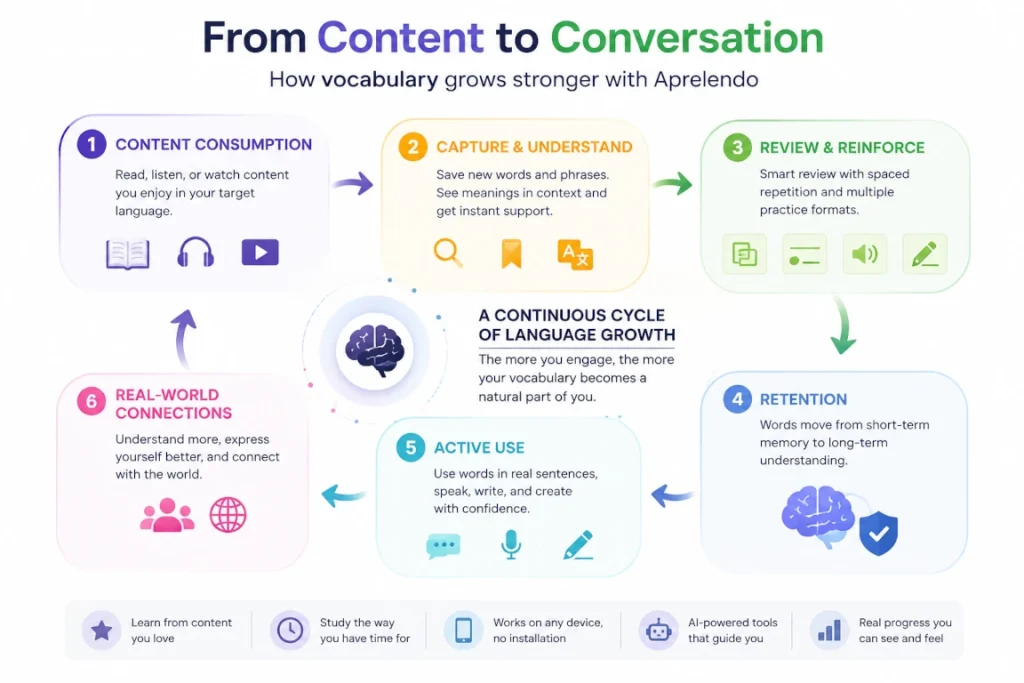
Beyond Flashcards: Multiple Ways to Learn the Same Vocabulary
Traditional flashcard systems primarily rely on one mechanism:
See the prompt.
Recall the answer.
Move on.
While effective, language learning benefits from multiple forms of retrieval.
Aprelendo allows learners to reinforce vocabulary through:
- Traditional flashcards
- Cloze deletion exercises
- Reading practice
- Listening practice
- Book and audiobook study
- Video-based learning
- AI-powered active recall activities
This variety matters because memory strengthens when information is retrieved in different contexts.
A word you’ve reviewed through flashcards, encountered in an article, heard in a video, and used in your own sentence becomes much harder to forget.
There’s also a practical advantage.
Not every day looks the same.
Some days you have thirty minutes to read.
Other days you only have five minutes between meetings.
With Aprelendo, you can switch seamlessly between deep learning sessions and quick reviews.
The platform adapts to your schedule instead of forcing you into a single study format.
Active Recall That Goes Beyond Recognition
Recognizing a word is not the same thing as using it.
Many learners discover this the hard way.
They can understand vocabulary during reviews but struggle to use those same words in conversations or writing.
This is where Aprelendo’s Lingobot-powered exercises create a fundamentally different learning experience.
After learning a vocabulary item, learners can generate their own example sentences and receive immediate feedback.
Instead of simply recognizing the word on a card, they actively produce language.
This matters because production is one of the strongest forms of learning.
When you create language yourself, you’re training communication skills—not just memory.
The result is a more direct path from understanding vocabulary to actually using it.
Mastering the Words You Always Confuse
Every language learner has a list of words that seem impossible to keep straight.
Maybe it’s “ser” versus “estar” in Spanish.
Or “for” versus “since” in English.
Or subtle vocabulary distinctions that dictionaries don’t explain clearly.
Aprelendo addresses this challenge through Nuance Battles.
Learners can create sets of commonly confused words and practice choosing the correct option in carefully designed example sentences.
The exercises are generated to ensure there’s only one correct answer, and explanations clarify why that answer works.
Instead of memorizing definitions, you develop an intuitive understanding of how words are actually used.
This type of practice targets one of the most frustrating gaps in traditional flashcard systems: nuance.
Everything You Need in One Place
One of Anki’s greatest strengths is flexibility.
Ironically, that’s also one of its biggest weaknesses.
Most learners end up building a patchwork system involving multiple tools:
- Anki for reviews
- A dictionary app
- A translator
- YouTube
- Reading apps
- AI tools
- Grammar resources
Aprelendo brings these experiences together.
Within a single environment, learners can:
- Read articles
- Read books
- Listen to audiobooks
- Watch YouTube videos
- Study offline videos
- Access integrated dictionaries
- Use translators
- Explore image dictionaries
- Ask questions to Lingobot
- Choose their preferred language resources
The platform doesn’t force learners into a single dictionary, translator, or workflow.
Instead, it allows them to choose the resources that fit their needs.
The less time you spend switching between tools, the more time you spend engaging with the language itself.
Which Tool Is Better for Different Types of Learners?
The truth is that neither tool is universally better.
They’re optimized for different goals.
Anki Is a Strong Choice If You:
- Enjoy building custom study systems
- Like complete control over your learning process
- Are comfortable creating and managing content
- Need highly specialized review decks
- Already have strong study habits
Aprelendo Is a Strong Choice If You:
- Want to learn from content you enjoy
- Prefer a system that requires less setup
- Value learning in context
- Want multiple review formats beyond flashcards
- Like receiving AI-powered feedback
- Read books, articles, or watch videos in your target language
- Want everything in one place
- Need a solution that works on any device without installation
For many learners, especially busy adults, reducing friction leads to more consistency—and consistency is what ultimately drives progress.
Final Verdict: Flashcard System or Language Ecosystem?
Anki remains one of the most powerful spaced repetition tools ever created.
If you enjoy building study systems, managing decks, and customizing every aspect of your workflow, it can be an excellent choice.
But most language learners aren’t trying to become experts in flashcard management.
They’re trying to understand movies.
Read books.
Follow conversations.
Connect with people around the world.
That’s where Aprelendo takes a different approach.
Instead of focusing solely on memory, it focuses on language acquisition as a whole.
You can learn from content you genuinely enjoy.
Practice through multiple activity types.
Receive AI-powered feedback.
Read, listen, watch, and review in a single environment.
And study whether you have thirty minutes—or three.
If you’re looking for a platform that combines the science of spaced repetition with the richness of real-world language exposure, Aprelendo was designed for exactly that purpose.
Ready to see what language learning looks like when everything works together?
Visit Aprelendo, import content you already enjoy, and start building vocabulary through reading, listening, watching, and active practice—all in one place.
Leave a Reply