
You know that awkward moment when you understand a language perfectly… but your mouth refuses to cooperate?
You can watch shows. Read articles. Follow memes. Maybe even understand your favorite YouTuber at full speed. But when it’s time to speak, your brain suddenly becomes a loading screen.
Here’s the surprising truth: speaking doesn’t actually begin with speaking. It begins with input.
More specifically, it begins with reading.
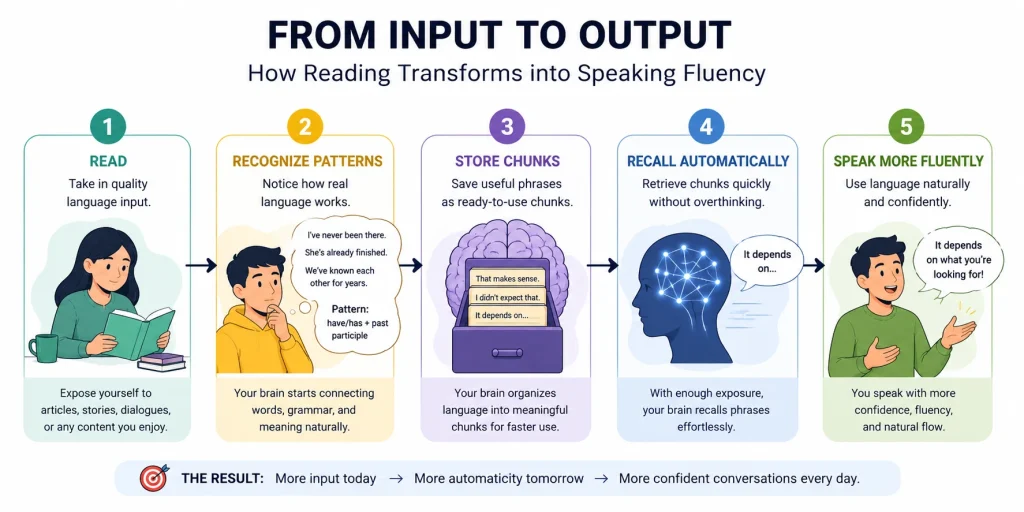
Most language learners treat reading as a “passive” skill and speaking as an “active” one. But your brain doesn’t separate them that neatly. The language you absorb through reading becomes the raw material your brain later uses in conversation.
In other words: every sentence you read is secretly training your future speaking ability.
Why Reading Feels Easier Than Speaking
Speaking is one of the most demanding things your brain can do.
When you speak in another language, your mind has to:
- Recall vocabulary
- Build grammar in real time
- Pronounce words correctly
- Understand the other person
- Respond fast enough to avoid awkward silence
That’s a lot happening at once.
Reading, on the other hand, gives your brain breathing room. You can pause. Re-read. Notice patterns. Connect meaning naturally.
And that slower process matters because fluency is built from recognition before production.
Think about how children learn their first language. They spend years listening and absorbing before they confidently speak in full sentences. Adult learners aren’t that different. Your brain still needs a large “mental library” of language examples before speaking feels natural.
That’s where reading becomes powerful.
Reading Builds the Invisible Foundation of Fluency
A lot of learners think vocabulary comes from memorizing word lists.
It doesn’t.
Your brain remembers language better when words appear inside meaningful situations. Reading gives you exactly that.
When you repeatedly encounter phrases like:
- “That makes sense.”
- “I’m looking forward to it.”
- “It depends on…”
- “To be honest…”
…your brain starts storing them as complete chunks instead of isolated words.
This changes everything.
Because fluent speakers don’t build sentences word-by-word like robots. They retrieve familiar language patterns automatically.
Reading trains this automaticity without you even noticing.
The more you read, the more your brain starts predicting how sentences should sound. You begin to “feel” what sounds natural. That instinct later shows up when speaking.
It’s why learners who read consistently often sound more natural than learners who only study grammar exercises.
They’ve absorbed rhythm, tone, and structure through repeated exposure.
Your Brain Loves Repetition (As Long As It’s Interesting)
Here’s something most textbooks get wrong: repetition alone isn’t enough.
Your brain pays attention to what feels relevant, emotional, or engaging.
That’s why reading content you actually enjoy matters so much.
A learner reading boring textbook dialogues about fictional grocery stores will struggle to stay motivated. But someone reading movie reviews, sports articles, travel blogs, or short stories gets repeated exposure without mental resistance.
And resistance matters.
Because language acquisition works best when your attention is naturally engaged.
This is also why graded readers, comics, subtitles, and even social media posts can dramatically improve speaking over time. They create low-pressure repetition.
The key isn’t reading “hard” material.
The key is reading material you’ll consistently return to.
Why Reading Improves Pronunciation Too
This part surprises many learners.
“How can reading improve speaking if there’s no sound involved?”
Because your brain constantly connects written language to internal sound patterns.
When learners read regularly while also hearing the language through videos, podcasts, or conversations, the brain begins syncing spelling, rhythm, pronunciation, and meaning together.
Over time, this strengthens what linguists sometimes call your “mental language map.”
That’s why learners who read frequently often:
- hesitate less,
- choose words faster,
- and pronounce common phrases more naturally.
They’re not translating anymore.
They’re recognizing.
And recognition is much faster than construction.
The Best Readers Notice Patterns Without Studying Them
One of the biggest breakthroughs in language learning happens when grammar stops feeling like math.
Reading helps this happen naturally.
Instead of memorizing rules like:
“Use the present perfect for unfinished time periods…”
…your brain simply sees the pattern repeatedly in real situations.
You read:
- “I’ve never been there.”
- “She’s already finished.”
- “We’ve known each other for years.”
After enough exposure, the structure stops feeling abstract. It starts feeling familiar.
This is how real fluency develops.
Not from constantly translating rules in your head, but from building intuitive pattern recognition through massive exposure.
That’s also why advanced learners often struggle to explain grammar rules even though they speak correctly. Their knowledge became automatic through repeated input.
How to Turn Reading Into Better Speaking
Reading alone won’t magically make you fluent overnight. But if you combine it with tiny speaking habits, the results accelerate fast.
Here’s a simple system that works:
1. Read Short Content Daily
Ten minutes every day beats one exhausting study session every weekend.
Consistency matters more than intensity.
Choose:
- short articles,
- dialogues,
- Reddit threads,
- graded readers,
- newsletters,
- or subtitles.
2. Read Out Loud Occasionally
This connects visual recognition with pronunciation and mouth movement.
You don’t need perfection. You’re training familiarity.
3. Steal Useful Phrases
Native speakers rely heavily on reusable sentence chunks.
Instead of memorizing isolated vocabulary, collect phrases like:
- “The thing is…”
- “I didn’t expect that.”
- “It turns out…”
These become instant speaking shortcuts.
4. Retell What You Read
After reading something short, summarize it aloud in simple language.
This is where input becomes output.
Even a 30-second summary forces your brain to retrieve vocabulary actively.
Why This Approach Feels Less Exhausting
Traditional language learning often feels like performance pressure.
Speak perfectly.
Remember every rule.
Don’t make mistakes.
Reading changes the experience completely.
It allows learners to absorb language before being forced to produce it. That lowers anxiety and builds confidence naturally.
And confidence matters more than most people realize.
Because when learners stop panicking about speaking, their brains process language faster and more efficiently.
In many ways, reading acts like a quiet rehearsal for future conversations.
You’re preparing your brain long before you open your mouth.
The Real Goal Isn’t Perfect English
At Aprelendo, we believe language learning isn’t about sounding flawless. It’s about connection.
Reading helps learners connect with ideas, humor, culture, and people before they ever enter a conversation.
And that connection-first approach changes motivation completely.
You’re no longer studying languages like a school subject.
You’re using it to understand the world.
That’s also why tools like the Aprelendo App are designed around meaningful exposure instead of endless memorization. The goal isn’t to overwhelm learners with rules. It’s to create consistent input that naturally turns into confident output over time.
Because fluency isn’t built in one perfect speaking session.
It’s built sentence by sentence, story by story, page by page.
And often, the fastest way to speak better… is to start reading more.
Leave a Reply