
You sit down with a novel, an article, or a newsletter in your target language. On one page, you have opened the dictionary twelve times and can no longer tell what the paragraph says. On another day, you read ten pages smoothly, enjoy it, and then wonder whether any of that reading will stick.
That tension is why the choice between extensive reading vs intensive reading matters. The two approaches ask you to pay attention in different ways. One protects time with the language and the pleasure of following a real idea. The other gives you a way to inspect language closely enough to reuse it later.
The useful question is not which method is superior. It is: what job does this reading session need to do?
The short answer: use two reading modes for two different jobs
Extensive reading means reading a relatively long stretch for meaning, continuity, and enjoyment. You keep moving. You accept that some words will remain fuzzy if the main thread still makes sense.
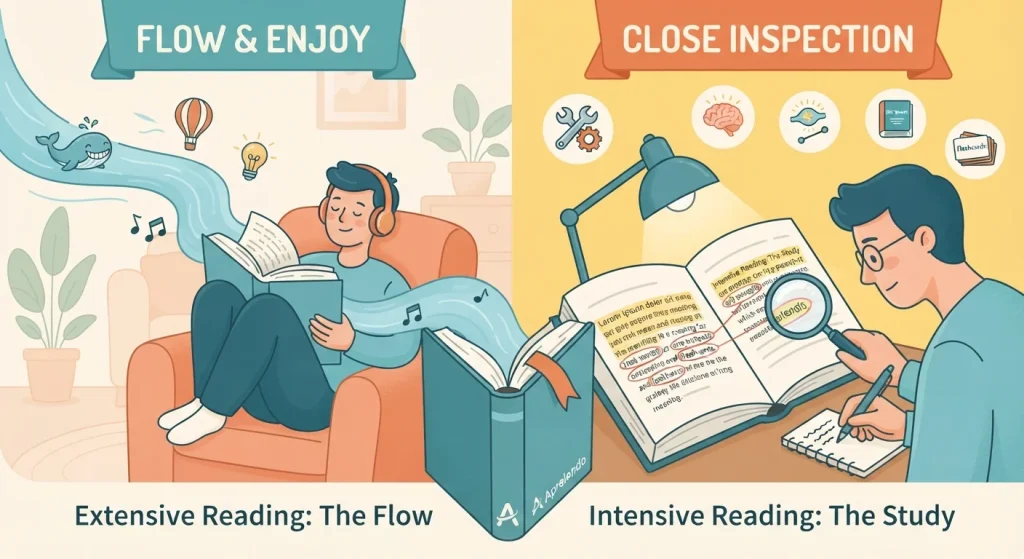
Intensive reading means working slowly through a short passage. You examine words, phrases, grammar, and the clues that connect sentences. The aim is not to finish a chapter. It is to leave with a small number of things you understand better and can review.
These are modes of attention, not permanent labels for books. You might read a detective novel extensively for several nights, then choose one lively paragraph from it for intensive study on Saturday. The text did not change; your purpose did.
Research on extensive reading reports benefits for second language learning, while also showing that results vary in what and how learners read. That variation matters in real life. A short opinion column, a long fantasy novel, and a recipe blog do not make the same demands. Nor do they suit the same reading mode every day.
Extensive reading is for building continuity with the language
Read enough to follow the main thread
In an extensive session, your first responsibility is to the story, argument, explanation, or voice of the text. If you can say what happened, what the writer thinks, or what you learned, the session did its main job.
That does not mean you understand every sentence. It means the unknown language has not taken over. You may miss the precise adjective in “the committee issued a tentative proposal,” but still understand that a group put forward a preliminary plan. Keep reading.
This matters because reading is partly a skill of connecting information across sentences. If every unfamiliar item stops you, the text becomes a row of disconnected dictionary entries. Sustained reading gives repeated exposure to grammar, word order, discourse markers, and recurring vocabulary in a setting where they have a purpose.
Let most unknown items pass when they do not block meaning
A word is not automatically worth interrupting for because it is new. In an extensive session, let it pass when you can infer enough from the sentence, when it is decorative rather than central, or when it appears only once and does not affect the main point.
Suppose you are reading a travel essay:
By dusk, the harbour had become a blur of masts, gulls, and impatient ferry passengers.
If dusk and masts are unfamiliar but you understand that it is evening at a harbour, there is no urgent need to stop. The scene remains intact. You may meet those words again, or you may decide later that by dusk is a useful phrase worth keeping. Either is fine.
Extensive reading still allows occasional lookup. Look up a word if it blocks the plot or the argument, recurs enough to become distracting, or interests you for a specific reason. The difference is that lookup is the exception, not the rhythm of the session.
Choose material you will actually return to
Interest is not a bonus feature. It affects whether you keep reading long enough to get repetition and range. A learner who follows football, architecture, skincare, history, gaming, or local politics already has background knowledge that can make authentic material more accessible.
Use that advantage. A familiar topic gives you predictions about what you are likely to hear or read. Visuals, headings, recurring formats, and a known author can do the same. You do not need a text to feel easy. You need enough anchors to remain oriented.
Intensive reading is for making a short extract yield more
Slow down for one short, high-value passage
Intensive reading works best when you put a boundary around it: one paragraph, a page, a scene, or a section of an article. “I will study this whole novel carefully” is usually a plan to stop reading the novel.
Choose an extract with a reason to study it. It might contain a phrase that keeps appearing in a podcast, a compact explanation of a topic you care about, or dialogue whose tone you want to understand. A good intensive text has enough substance to reward attention, but it is short enough to finish without exhaustion.
Investigate more than single words
When you slow down, do not reduce the passage to translations. Look at what the language is doing.
Imagine the sentence: “She brushed off the criticism, saying the figures did not tell the whole story.”
A close reading might notice:
- brush off means dismiss here; it is not about cleaning something.
- the figures refers to numbers or data, not physical shapes.
- did not tell the whole story is a useful way to say that data gives an incomplete picture.
That is more useful than a list reading “brush = cepillo; figure = figura; story = historia.” You have learned a meaning, a phrase, and the relationship between the two clauses.
Leave with a small, reviewable harvest
The point of intensive reading is not to collect proof that the passage was difficult. It is to choose a handful of items you can realistically revisit.
Save the relevant sense, the original sentence or a short excerpt, and any phrase or collocation that makes the item usable. If you save take issue with, keep enough context to remember that it means to disagree with or object to something. If you save a sharp decline, keep the noun phrase rather than only sharp.
This selective follow-up is one reason a mixed routine makes sense. Incidental learning through meaning-focused input can produce vocabulary gains, but a meta-analysis found that the proportion of target words retained varied substantially by condition and assessment. Repeated encounters and deliberate attention can help, but no one reading session turns every unknown item into durable vocabulary.
Choose the mode before you start
The simplest way to avoid a frustrating session is to decide the purpose first.
Use extensive reading when you want flow, range, or enjoyment
Choose extensive mode when you want to follow a story, get the gist of a news feature, build the habit of reading, or spend more time inside the target language without turning every minute into analysis.
A good question is: “Can I keep following the main thread if I do not solve every unknown word?” If the answer is yes, protect that continuity. Make a quick mark beside one or two intriguing items if you want, then move on.
Use intensive reading when a passage repays attention
Choose intensive mode when you have a short extract, a clear question, and enough time to investigate it. Perhaps a paragraph is packed with useful professional language. Perhaps you want to understand why a joke works. Perhaps a repeated expression is still unclear after several encounters.
Intensive reading is also a good repair tool. If a scene confused you during extensive reading, return to just that scene later. You do not need to restart the book and translate it line by line.
Switch or stop when the text defeats its intended task
If an extensive session has so many unknowns that you cannot tell who did what, change something. Try a shorter text, a familiar genre, an edition with a glossary, an audio version, or a summary before you read. If the material still offers no foothold, park it.
A difficult text is not a character test. It may be excellent material for a future version of you and poor material for tonight. If this mismatch keeps appearing across reading and listening, use the intermediate-plateau diagnostic to identify the bottleneck rather than raising the difficulty at random.
Lexical-coverage research is useful here as a reminder that unknown-word density affects comprehension. When too much vocabulary is unfamiliar, unassisted comprehension becomes harder. So, use your actual experience of the page, rather than a target percentage, to choose a better fit.
A realistic weekly split for an intermediate learner
You do not need to schedule every minute. A simple 30/20/10 template can help when you are unsure how to balance flow and study:
- 30 minutes of extensive reading: an enjoyable, manageable text with interruptions kept low.
- 20 minutes of intensive reading: a short extract from a current or recent text.
- 10 minutes of recall or review: revisit a small set of saved phrases and try to remember the situation or complete the sentence.
This is a design pattern, not a prescription. Some weeks you may have four short extensive sessions and only one intensive session. During exam preparation or a demanding work project, the balance may tilt toward close reading. If reading for pleasure has disappeared from your routine, start by restoring that first.
A sample seven-day schedule
On Monday, Wednesday, and Friday, read 20 to 30 minutes of a novel, comic, blog, or newsletter extensively. On Tuesday, select one paragraph from Monday’s reading and study it for 15 to 20 minutes. On Thursday, do the same with a different passage. At the weekend, reread your saved items briefly and spend one more relaxed session with the flow text.
Notice what this plan avoids. You are not trying to mine every page. You are also not leaving all learning to chance. Volume and attention each have a place.
Use authentic texts without making them too hard
Build a genre ladder
Authentic material does not have to begin with a classic novel or a dense newspaper editorial. Move through genres that offer more support: illustrated explainers, familiar YouTube-channel transcripts, hobby blogs, interviews, short columns, then longer fiction or analysis.
A text can be authentic and still be a poor fit today. Legal commentary full of institutional vocabulary may be harder than a lively personal essay. A novel may be harder than a technical article if the novel relies on dialect, cultural references, or subtle narration.
Try a one-paragraph sampling test
Before committing, read one paragraph without a dictionary. Can you identify the topic? Can you connect the main actions or claims? Do you recognise enough repeated language to predict what comes next? Would you willingly read another paragraph?
If yes, try it extensively. If not, use a scaffold or choose something else. A summary, glossary, audio version, or a shorter extract can turn “too hard” into “studyable,” but it may also be more sensible to save the text for later.
Common mistakes that make both modes less useful
Treating every unknown word as a task
This is the fastest way to turn extensive reading into slow translation. Reserve close investigation for blockers, recurring items, and language you genuinely want to use. For a focused decision rule, see Should You Look Up Every Unknown Word?.
Reading only slowly and never building volume
Close study feels productive because you can point to each word you examined. But if all reading is intensive, you get little practice at tolerating ambiguity, following longer arguments, and recognising familiar language at normal speed.
Calling passive scrolling extensive reading
Extensive reading still involves attention. If you are skimming while distracted, pause occasionally to state the main point or predict what comes next. You do not need a worksheet; you do need enough engagement to follow the text.
Saving everything
A large bank of isolated highlights can become an archive you never revisit. Save fewer things, with better context. A short set you can recall is more useful than fifty words you vaguely remember marking.
An Aprelendo workflow for keeping the modes separate
You can run this routine with a print book, a browser, or a notebook. If you use Aprelendo, the division can be visible in your actions: read an extensive text with minimal interruption, then open a short passage for intensive work, use in-context lookup, and save only a few contextual items for later review.
The tool is secondary to the boundary. The important move is deciding whether today’s reading is for continuity or investigation before you begin.
Frequently asked questions
Is intensive reading better than extensive reading?
No. Intensive reading is better for a short, deliberate investigation; extensive reading is better for sustained exposure and following meaning over time. A useful routine usually includes both, in proportions that match your goals and available time.
How much extensive reading should I do each week?
Aim for an amount you can repeat without resentment. Three or four short sessions are often easier to sustain than one heroic weekend session. If you are rebuilding a habit, ten enjoyable minutes count.
Can I use native material for extensive reading?
Yes, if you can follow enough to stay oriented and interested. Start with a familiar topic or a genre with support. Native material that is far beyond your current access may be better used intensively in a small excerpt, with a scaffold, or later.
Should I use a dictionary while doing extensive reading?
Use it selectively. Look up words that block the main thread, recur, or matter personally. Let many other unknowns pass. The next article in this cluster offers a blocker/bridge/bonus rule for making that choice quickly.
Give each reading session one job
For your next text, decide before the first sentence: am I reading to stay with the writer’s meaning, or am I studying one short part closely?
If it is a flow session, keep the dictionary closed until a true blocker appears. If it is a study session, choose one compact extract and stop after you have a small set of phrases worth revisiting. That boundary makes reading more sustainable, and it leaves room for both enjoyment and deliberate learning.
Sources
- Nation, I. S. P. (2006). How Large a Vocabulary Is Needed for Reading and Listening? The Canadian Modern Language Review / La revue canadienne des langues vivantes, 63(1), 59–81. https://doi.org/10.1353/cml.2006.0049
- Sangers, N. L., van der Sande, L., Welie, C., Dobber, M., & van Steensel, R. (2025). Learning a Language Through Reading: A Meta-analysis of Studies on the Effects of Extensive Reading on Second and Foreign Language Learning. Educational Psychology Review, 37(4), 96. https://doi.org/10.1007/s10648-025-10068-6
- Webb, S., Uchihara, T., & Yanagisawa, A. (2023). How effective is second language incidental vocabulary learning? A meta-analysis. Language Teaching, 56(2), 161–180. https://doi.org/10.1017/s0261444822000507
Leave a Reply