
You can hold a conversation, follow a familiar podcast topic, and read an article if you have time. Yet fast speech still blurs; novels take forever; words you recognize refuse to appear when you need them. More hours of the same routine can make this feel worse, because the effort is real and the evidence of progress is hard to see.
That is the intermediate language learning plateau for many B1–B2 learners. It is usually not a single barrier and it is rarely fixed by a dramatic reset. Early progress is conspicuous: you go from not understanding a menu to ordering dinner. Later progress often appears as a slightly better retell, fewer look-ups, or recognizing a phrase you missed last week.
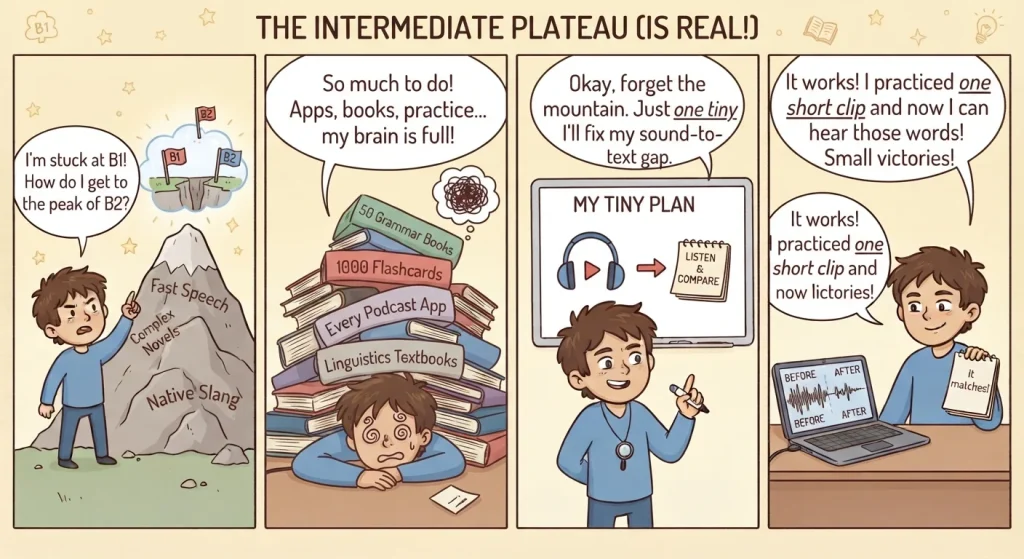
Treat the feeling of being stuck as a diagnosis problem. Find the part of processing that is failing most often, change one thing for two weeks, and record an observable result. The five patterns below are deliberately narrow. You do not need to repair all of them at once.
Start with a five-symptom self-audit
Choose the sentence that best describes a frustrating recent session. Then run the matching experiment before changing your apps, timetable, grammar book, and input all at once.
| What happens | Likely bottleneck | Do not assume | Two-week experiment |
|---|---|---|---|
| “I know the words in captions but lose them in normal speech.” | Sound-to-text mapping, reductions, word boundaries, or an unfamiliar voice | That you have no listening ability | Use one short clip with a transcript; log a few places where the sound and text did not match for you |
| “I understand sentences but lose the point of the video or article.” | Main-thread comprehension and attention allocation | That every unknown word caused the problem | Follow one recurring topic and make a short retell before checking details |
| “I can read, but authentic texts are painfully slow.” | Material fit, interruption, or insufficient reading volume | That you must translate more carefully | Read a shorter, better-matched text and classify unknown words before looking them up |
| “I recognise plenty, but my speech and writing sound repetitive.” | Retrieval of phrases and patterns | That another long word list will solve it | Keep a small set of useful phrases in context; recall them from a situation, not from a translation |
| “I avoid anything unless I understand almost all of it.” | Tolerance of partial understanding or a poor material match | That forcing harder content builds tolerance | Use familiar-topic material with visual or contextual anchors, and decide whether to persist, scaffold, or park it |
A symptom is a working hypothesis, not a label. If your retells improve but you still cannot retrieve phrases in conversation, the listening experiment did its job: it ruled out one explanation rather than fixing every part of the language.
Experiment 1: close the sound-to-text gap
If subtitles feel easy but the audio does not, do not begin with an hour of audio-only listening. Use a short clip that gives you a fair chance: one speaker, a familiar subject, clear enough sound, and target-language captions or a transcript.
Watch once for the main idea. Then replay 20 to 40 seconds and compare what you heard with what was said. Keep a tiny mismatch log:
- heard: gonna see it
- text: going to see it
- likely issue: reduction and words running together
Another entry might show that you knew the written word but did not expect that speaker’s pronunciation, or that you had placed the word boundary in the wrong spot. The point is not to create a catalogue of errors. It is to see whether the recurring problem is reduced speech, a missing word, an accent, or attention drifting from the meaning.
On a later day, replay the same segment without captions and say the main point aloud in your own words. A delayed replay is more informative than repeatedly reading along, because it asks whether the sound is becoming recognisable on its own.
Research on learning vocabulary through L2 television found that gains varied with prior vocabulary knowledge, frequency of occurrence, and cognateness. That is a useful warning against treating one caption setting or one viewing style as universally best. Use captions as a scaffold when they make the audio usable; use brief audio-only replays to test what remains after the scaffold is removed.
For a fuller choice of caption mode, see Target-Language Subtitles, Native-Language Subtitles, or No Subtitles?. For a complete session structure, see A 20-Minute YouTube Study Loop.
Experiment 2: improve main-thread comprehension
A learner can decode many sentences and still miss the argument, plot, or speaker’s position. In this case, pausing for each unknown item often makes the problem worse. Your attention keeps returning to a local detail before you have built a model of the whole.
Choose a recurring content lane for two weeks: match reports, cooking videos, city-planning channels, book reviews, or whatever you would plausibly follow in your first language. Familiar formats reduce the number of things you must infer at once. A presenter who begins with a claim, gives examples, and ends with a verdict is easier to track than an unrelated clip every day.
For each session:
- Preview the title, source, visuals, and first few seconds. Predict the topic.
- Read or watch straight through for the main thread. Do not stop for ordinary unknown words.
- Record a 30–60 second retell before checking details: What was the point? What happened first? What evidence or example do you remember?
- Check only the gap that changed your retell substantially.
Compare day 1 and day 14 retells. A better retell may mean clearer sequence, fewer invented connections, more accurate main claims, or less time needed to start. It does not need to be longer.
Experiment 3: reduce reading friction without translating the page
Slow reading comes from several places: a text may be too dense for today’s purpose; you may be stopping too frequently; or you may be reading only short, difficult extracts and never building stamina. A recent meta-analysis reports benefits from extensive-reading programs but also variation in how those programs are designed and implemented.
Make the next two weeks a material-and-task experiment. Select short texts from a familiar genre. Before committing, sample one paragraph. Can you state the basic point without checking every unfamiliar item? Do you want to continue? If neither answer is yes, use a scaffold, choose an easier piece, or save it for later.
Then make lookup decisions quickly. Use the blocker, bridge, and bonus rule rather than translating the page line by line. If nearly every item is a blocker, the material or the task is mismatched. Lexical coverage is a way to think about the fit between a reader’s vocabulary and a particular text, not a personal level diagnosis or a target you can reliably estimate while reading.
Meaning-focused exposure can contribute to vocabulary learning, but it is not a promise that every word encountered becomes available for use. A meta-analysis of incidental L2 vocabulary learning examined proportional gains from meaning-focused input across primary studies; that is a good reason to combine reading volume with selective noticing and later retrieval.
Extensive vs. Intensive Reading offers a weekly split between flow and close study. Should You Look Up Every Unknown Word? covers the full selective-lookup method.
Experiment 4: turn recognition into retrievable language
Recognition and retrieval are different jobs. You may instantly understand I was hoping you could… in a video and still say I want you to… in every polite request. The missing piece is often a usable chunk linked to a situation, not another isolated synonym.
For two weeks, save only a few phrases that meet all three conditions:
- You can imagine a real situation where you would use them.
- The phrase includes the words around the target item that make it natural.
- You can keep the original sentence, a short excerpt, or a timestamp.
Instead of reviewing a card that says to figure out = descubrir, prompt yourself with a situation: “Your colleague solved a confusing technical problem. What could you say?” Then try to retrieve She figured out why the system was failing. If you cannot, reveal the phrase and say or write a new version that fits your life.
Keep the harvest small enough to revisit. The exact number matters less than whether the items return to your attention. A review pile that grows faster than you can use it is an archive, not practice.
Aprelendo can be useful here if you already read or watch through it: save the relevant sense together with its source sentence, then review it as contextual language. The same principle works with a notebook or any flashcard system that preserves context.
Experiment 5: build tolerance for partial understanding
Partial understanding is not a character test. Sometimes it is productive uncertainty; sometimes it means the material offers too few anchors to work with.
Give yourself anchors before you decide which situation you are in. Use a subject you know, visuals that clarify the action, a recurring speaker, a familiar genre, or a short introduction in the target language. After a first pass, ask three practical questions:
- Can I name the topic or situation?
- Can I follow enough of the main thread to make a rough retell?
- Do repeated words, visuals, and context give me a way in on a second pass?
If the answer is mostly yes, persist with a limited amount of support. If you can follow the topic but miss what people are saying, use the transcript or captions to investigate a short section. If there is no main-thread comprehension even with support, park the item. “Native content” is a description of who made it, not a guarantee that it is the right material today.
Measure progress without pretending you changed CEFR level in two weeks
Two weeks is enough to observe a habit and gather a little evidence. It is not a credible deadline for declaring a level change. Use measures that fit the bottleneck you chose:
- Listening: How many previously missed phrases do you recognize on a delayed replay? What kinds of mismatch recur?
- Main-thread comprehension: How accurate and specific is your first retell before you check details?
- Reading: How many true blockers appear per page or per short article? Can you maintain the thread with fewer interruptions?
- Retrieval: Can you complete or adapt a saved phrase when given a situation?
- Ambiguity tolerance: Can you decide to persist, scaffold, or park material based on evidence rather than panic?
Do not use these numbers to rank yourself. Their value is comparative: your own day-1 result against your own day-14 result on similar material.
A minimal two-week reset
Pick one symptom from the audit. Schedule three exposure sessions that fit it, two short targeted sessions, and a small review loop. Keep the material lane consistent enough that your comparison means something.
For example, a learner with a sound-to-text gap might watch three short clips from one channel for meaning, inspect two brief transcript segments, and replay the first clip without captions near the end of the fortnight. A learner with reading friction might complete three easy flow sessions, closely study two short extracts, and revisit a handful of selected phrases.
Everything else can stay stable. That restraint is the point. If you change input, vocabulary method, grammar study, speaking practice, and sleep schedule on Monday, a better Friday tells you almost nothing about why it improved.
When the issue is not a plateau
Your material is mismatched
A difficult novel, a fast panel discussion, or a technical article can be a bad match for your current task even when it is interesting. Change the text, genre, support, or goal before concluding that you need more willpower.
You need output feedback
Authentic input can give you language to notice and reuse. It cannot reliably tell you that your pronunciation obscures a contrast, that your word order sounds unnatural, or that your email is too direct for its context. If a retrieval experiment reveals the same output problem repeatedly, add a teacher, tutor, exchange partner, or carefully designed correction process.
Fatigue, time, or goals have changed
A routine that worked during a quiet month may be impossible during an exam period, move, or demanding job. Shrinking the session while preserving its purpose is often more useful than treating a changed life as an intellectual failure.
FAQ
How long does the intermediate plateau last?
There is no universal duration. It depends on the language, your starting point, the kind of progress you need, time available, feedback, and the material you use. A more useful question is whether one measurable part of the routine is moving after a focused experiment.
Can I get from B1 to B2 through input alone?
Input is central for building comprehension and noticing how language is used, but it may not supply the feedback or deliberate retrieval practice you need for every goal. If you need accurate speaking or writing in high-stakes settings, add opportunities for feedback.
Should I stop studying grammar?
Not necessarily. Keep grammar study when it helps you understand or express something that recurs in your input. If grammar exercises are replacing all meaningful reading, listening, and use, rebalance rather than abolish them.
Why do I understand subtitles but not speech?
Captions remove the problem of segmenting a fast sound stream into words. They can help you connect sound and spelling, but reading along does not automatically show what you can recognize by ear. Use a short audio-only replay after an accessible captioned pass.
What should I do if I understand almost nothing in native content?
Change the conditions: choose a familiar topic, shorter clip, clearer speaker, visual support, or a transcript. If you still cannot identify the topic or main thread, park the item and choose a better bridge into authentic material.
Choose one experiment for your next session
Do not wait for the plateau to disappear as a feeling. Pick the symptom that caused the most friction this week, run its smallest experiment, and write down one result you can compare later. A clearer retell, fewer blockers, or one phrase retrieved at the right moment is modest evidence, but it is evidence. Build the next session from that.
Sources
- Sangers, N. L., van der Sande, L., Welie, C., Dobber, M., & van Steensel, R. (2025). Learning a Language Through Reading: A Meta-analysis of Studies on the Effects of Extensive Reading on Second and Foreign Language Learning. Educational Psychology Review, 37(4), 96. https://doi.org/10.1007/s10648-025-10068-6
- Webb, S., Uchihara, T., & Yanagisawa, A. (2023). How effective is second language incidental vocabulary learning? A meta-analysis. Language Teaching, 56(2), 161–180. https://doi.org/10.1017/s0261444822000507
- Peters, E., & Webb, S. (2018). Incidental vocabulary acquisition through viewing L2 television and factors that affect learning. Studies in Second Language Acquisition, 40(3), 551–577. https://doi.org/10.1017/s0272263117000407
- Nation, I. S. P. (2006). How Large a Vocabulary Is Needed for Reading and Listening? The Canadian Modern Language Review / La revue canadienne des langues vivantes, 63(1), 59–81. https://doi.org/10.1353/cml.2006.0049
Leave a Reply